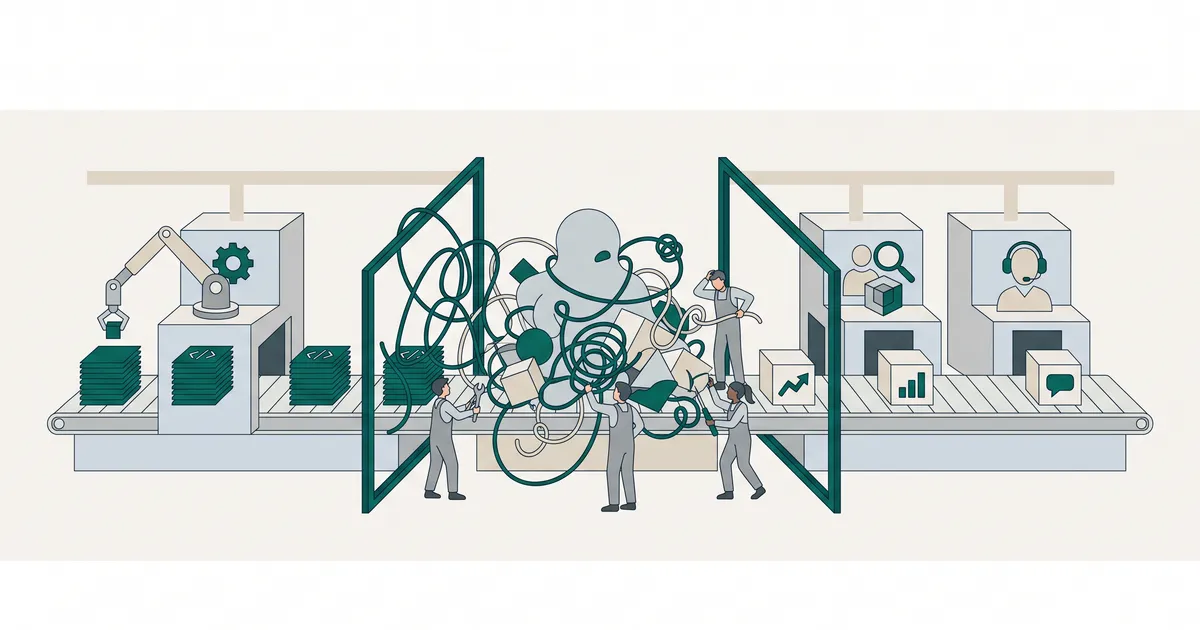
Most AI agent deployments fail for the same reason: teams try to replace a whole role instead of automating a narrow, well-defined loop. The ones that work are boring on paper (deflect order-status queries, draft PRs from GitHub issues, run SDR outreach) and pay back in months. What follows is what we tell clients when they ask which agents are worth building, which to buy, and what to stop trying.
What an AI agent actually is (and how it differs from a chatbot or RPA)
An AI agent is software that receives a goal, breaks it into sub-tasks, executes them using tools, and verifies the result. It runs in a loop rather than producing a single reply and stopping.
The chatbot comparison is straightforward. A chatbot answers "where is my order?" with text. An agent checks the order system, confirms delivery status, opens a ticket if the shipment is delayed, notifies the operations team and logs the exchange, all from one trigger. Same input, entirely different output surface.
The RPA comparison is more instructive, because RPA already automates things. The difference is exception handling. RPA follows a deterministic script and breaks the moment reality deviates from it. An agent evaluates the situation, decides, and adapts. The strongest production pattern we see is not agents replacing RPA but agents orchestrating existing RPA bots, adding a decision layer on top of automation that already runs.
A useful mental model
If you can write the rules in a flowchart and they cover every case, use RPA or a workflow tool. If the decision requires reading context, use an agent. If the process is one question and one answer, use a chatbot or a form.
The adoption gap: why the headline numbers mislead you
Vendor decks quote whichever number sounds best. Read them together and a different picture emerges.
McKinsey's 2025 State of AI puts enterprise AI use at 88% of organisations in at least one function, yet only 23% are scaling agentic AI anywhere in the business. PwC's 2026 CEO Survey of 4,454 executives found only 12% of CEOs have hit both revenue gain and cost reduction from AI. McKinsey also reports that nearly two-thirds of enterprises have experimented with agents, but fewer than 10% have scaled them to tangible value.
Gartner predicts over 40% of agentic AI projects will be cancelled by end of 2027, blaming unclear ROI and weak risk controls. Writer's 2026 survey of 1,200 executives and 1,200 employees found 79% of organisations report challenges adopting AI, and 48% now describe adoption as a "massive disappointment", up from 34% the year before.
The positive numbers are real too. Of organisations that have deployed agents, PwC's AI Agent Survey (308 US executives, April 2025) found 66% report productivity gains, 57% cost savings and 55% faster decision-making. Early adopters see 20 to 30% faster workflow cycles in back-office operations. 31% of enterprises have at least one agent in production, with banking and insurance leading at 47%.
The honest read: adoption is wide, scaled value is narrow. If you assume everyone else is further along than you, you will overpay and rush deployment. They are not.
The use cases with real payback
Coding agents
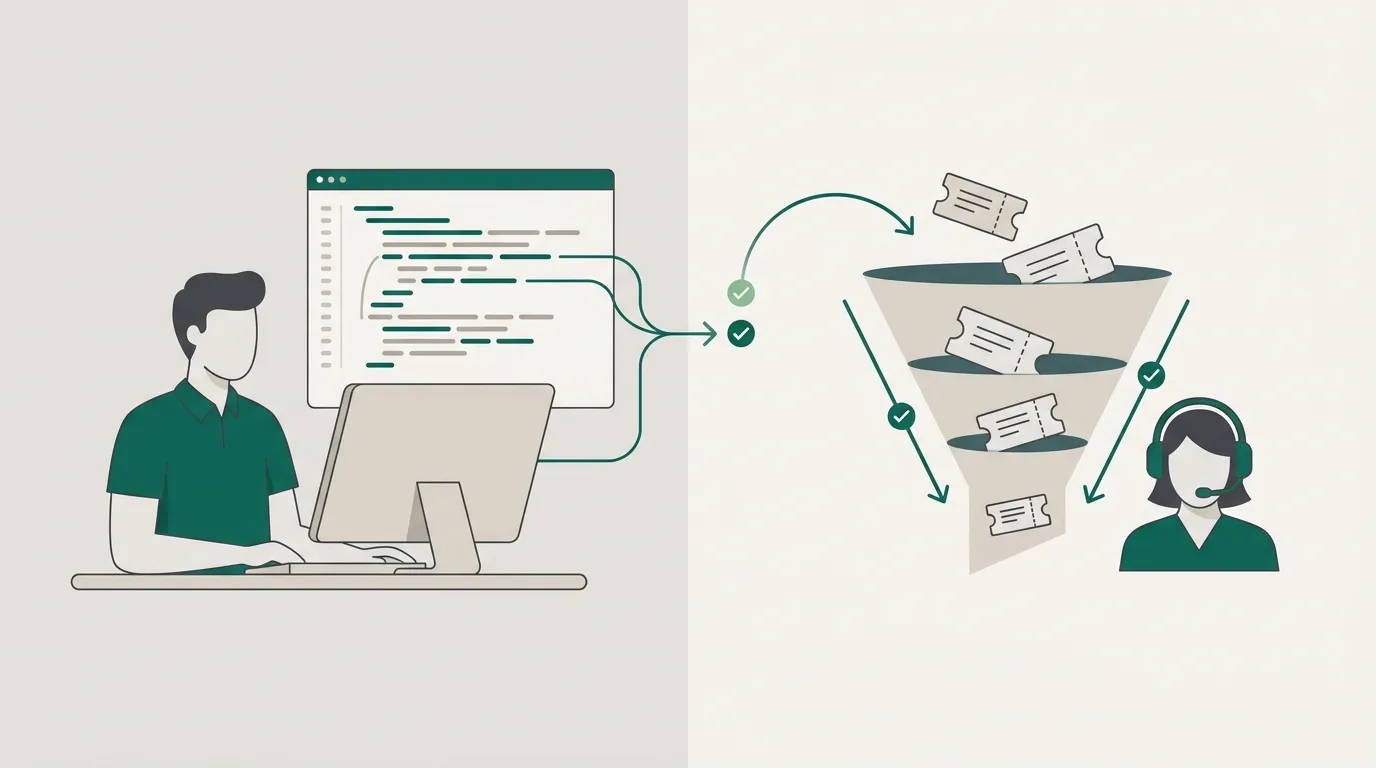
This is the clearest win. GitHub Copilot's coding agent mode went generally available to paid subscribers in September 2025, can be assigned GitHub issues directly, opens a draft PR and works autonomously via GitHub Actions. Cursor is reportedly the most popular AI code editor of 2026, with an annualised run-rate approaching $1B. Claude Code, Devin and OpenAI Codex round out the shortlist.
The numbers back it up. Stack Overflow's 2026 Developer Survey reports 71% of professional developers use an AI coding agent at least daily. 18% of merged PRs in surveyed enterprises list a coding agent as primary author or pair-coder. An MIT Sloan study found a 14% increase in shipped features per engineer-quarter for teams that deployed coding agents in 2025.
Our own position is simpler: if you build software and are not using coding agents in review and scaffolding, you are giving up compounding time.
Customer support agents
Support agents work when scoped tightly. The pattern we deploy is a tier-0 layer that deflects 30 to 50% of order-status and account queries and escalates everything else to a human quickly. Named tools worth shortlisting: Intercom Fin, Ada, Decagon, Salesforce Agentforce (which has matured into a proactive system embedded in Salesforce Data Cloud).
The failure mode is trying to replace the whole support function. Every deployment we have seen that promised to handle 80% of tickets produced worse CSAT and more escalations than the baseline. Scope the tier, measure deflection and CSAT weekly, expand only when both hold.
Sales and operations agents
SDR agents have the fastest payback of any function we have data on: median 3.4 months per BCG and Forrester's 2026 surveys, with human-in-the-loop rates as low as 8% because outbound prospecting is structurally narrow. 41% of marketing organisations run at least one SDR agent, and enterprises running them report 19% of net-new pipeline sourced through agentic outreach in Q1 2026. Apollo AI, Outreach, Salesforce Einstein and Relevance AI are the usual shortlist.
Operations agents are where multi-agent systems earn their keep. Zapier Central, MindStudio, Gumloop and CrewAI let you chain agents into what Google Cloud's 2026 AI Agent Trends report calls a "digital assembly line", where one agent orchestrates others end to end while humans set strategy and review at checkpoints. Well-integrated automation saves 12 or more hours weekly in typical deployments.
What still does not work
Generalist agents that claim to replace multiple roles. Without hard task boundaries they produce inconsistent output, miss context and create more error-correction work than they save.
The maintenance trap is real. Gartner's AI Reliability Index flags this as a primary concern for 85% of organisations: agents that require more human hours to fix than they save. If your agent needs constant babysitting, it is not an agent, it is a very expensive intern.
Strategic and executive decision-making is another area where agents consistently disappoint. Executives do not trust AI for strategic calls, and the underlying data is too messy, contextual and political for that trust to be warranted yet. What does work is AI as decision-support prep: the agent assembles the analysis, a human delivers the call.
Then there is the production gap. Moving from demo to always-on production is where most deployments stall. Deloitte's 2026 State of AI found only one in five companies has a mature governance model, and the AI skills gap is cited as the biggest integration barrier.
Adoption is wide, scaled value is narrow. Assume everyone else is further along than you and you will overpay.
Get plain-English guides like this in your inbox.
One short email a month. WordPress, Shopify, SEO, no fluff. Unsubscribe in one click.
We never share your email.
Build vs. buy: a practical decision framework
The framework landscape is crowded: LangGraph, LangChain, CrewAI, AutoGen, OpenAI Agents SDK, Mastra, Semantic Kernel, LlamaIndex, Haystack, Rasa, Anthropic's Agent SDK. For no-code business workflows, Lindy is the usual pick. For stateful, production-grade multi-agent systems, LangGraph or CrewAI. For Microsoft-stack enterprises needing multi-agent flows with human oversight, AutoGen. If you are already on Salesforce, Agentforce is the default.
The heuristic we give clients as part of our AI development services: start off-the-shelf. Evaluate against your real workload for two to four weeks. Build custom only when the gap is large and the volume justifies the ongoing maintenance cost. Custom builds make sense in exactly two situations: high volume where per-run economics matter, or a workflow that is itself the competitive moat.
That principle is not unique to AI. If you want the longer version of that argument, see build vs buy: when custom software beats off-the-shelf. And if you are considering an agent as part of a broader product, the same discipline applies to feature scope, which we cover in adding AI features to your product without the hype.
One structural shift worth watching: as MCP (Model Context Protocol) and agent-to-agent protocols stabilise, switching costs between underlying models drop, and margin transfers from foundation-model providers to whichever layer holds the workflow context. Bet on the layer, not the model.
Governance is not optional
76% of technology leaders say governance is extremely important for agentic AI, yet only one in five companies has a mature governance model. The companies whose projects Gartner expects to be cancelled in 2027 are the ones that skipped this in 2025 and 2026.
Before you deploy anything into production, check these:
- Vendor SOC 2 compliance and enterprise-grade end-to-end encryption.
- A clear, contractual opt-out for training on your data.
- Guardrails on which tools the agent can call and which data it can read.
- Monitoring with alerting on cost, latency, tool-call failures and unusual behaviour.
- Human approval on any action that writes to a system of record, sends external communication, moves money or touches personal data.
- Grounding on your own data through retrieval rather than fine-tuning where possible. See RAG explained: grounding AI on your own data for why this matters.
If you cannot answer all six on day one, do not go live. Pilot with a human in the loop until you can.
Where to start if you have not deployed an agent yet
The playbook we use with clients:
- Pick one narrow, high-volume, low-risk task. Order-status deflection, SDR outreach and PR-drafting on internal tools are all good candidates. Avoid anything that touches money, personal data or public communications on day one.
- Buy before you build. Trial two off-the-shelf tools that fit your stack for a fortnight against your real workload.
- Measure the honest baseline. How long does the task take a human today, at what quality, at what cost. Without this you cannot tell whether the agent is winning.
- Set the exit criteria before you start. Deflection rate, CSAT, cycle time, error rate. If the agent misses them, kill or narrow the scope.
- Add governance before scale, not after. Monitoring, guardrails and human approval on sensitive actions from day one.
- Expand scope only after two months of stable metrics.
The teams that succeed treat their first agent the way a good engineering team treats a new service: narrow contract, clear metrics, observable, reversible. The ones that fail treat it as a magic box.
If you want a second pair of eyes on which agent to try first, talk to us about your first agent deployment. We will tell you honestly whether an agent is the right tool, and if not, what is.