Senior engineers · since 2023
Web design & development
Custom WordPress builds and bespoke marketing sites, from single-purpose brand sites to multi-page lead-gen sites. Bricks/ACF where useful, headless when justified.
01 — What we build
Built for production, end to end.
Custom themes, no page-builder bloat
We hand-write theme templates in PHP rather than leaning on Elementor or Divi. The site stays fast and maintainable, with no plugin debt accumulating over the eighteen months after launch.
Editor-friendly content modelling
Content is modelled in ACF field groups and Gutenberg block patterns, or in Bricks where the marketing team wants visual control. Editors add pages, swap hero sections and publish without raising a ticket.
Core Web Vitals from the first commit
Templates are built to pass Core Web Vitals on real devices, with images shipped in modern formats. Speed is a constraint from day one, not a phase bolted on at the end.
Structured for SEO by default
Structured data is baked into the templates that matter, and information architecture and internal linking are planned so Google can crawl and rank the site. Every build leaves with on-page SEO foundations and analytics already in place.
Functional layer when the brief needs it
We build what WordPress is genuinely good at: job boards on WP Job Manager with real filtering, WooCommerce stores and course catalogues, plus membership, booking and gated-content flows. The same toolkit scales from a five-page brand site to a content-heavy platform.
Rescue and migration
About a third of our work is recovering inherited Elementor builds and abandoned bespoke themes, always starting with an audit and a recovery plan. Content migration and a verified 301 redirect map are part of every rebuild, so ranking equity moves across intact.
WordPress is the right call for a lot of businesses, especially when content ownership, editor familiarity, and the cost of a slip-up matter more than the upside of a heavier framework. We build custom themes from scratch in Gutenberg block patterns when the editorial team is the primary audience, or in Bricks plus ACF when the brief is closer to a custom design system with marketing-team flexibility.
No page-builder bloat
Page-builder bloat is the silent killer of a WordPress build. Elementor, Divi and similar tools win the demo, then lose the next eighteen months as the site slows down, accumulates plugin debt, and outgrows what the team can actually edit. Every build here is a custom theme, hand-written templates in PHP, structured data baked in, and a sensible plugin choice for the few things WordPress genuinely needs help with.
Editing without a developer
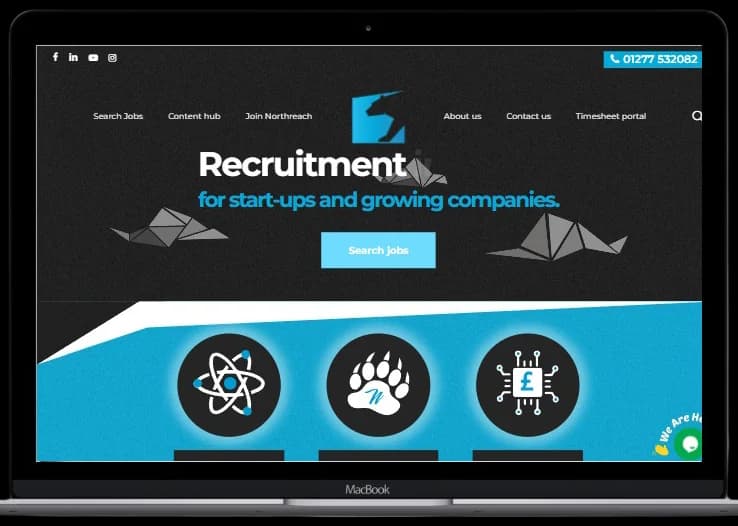
The point of a custom build is that the people who live in the site can run it. We model content in ACF field groups and Gutenberg block patterns, or in Bricks where the marketing team wants visual control, so editors add pages, swap hero sections and publish without raising a ticket. Northreach is a good example: the recruitment team adds jobs, categories and articles daily, all from the WordPress admin, because the theme was built around the way they actually work.
Functionality when the brief needs it
A marketing site is often only the start. We build the functional layer WordPress is genuinely good at: job boards on WP Job Manager with real filtering, WooCommerce stores and course catalogues, membership and gated content, booking and enquiry flows, and downloadable resources wired through ACF. SanData runs a thousand-plus course catalogue and booking on WooCommerce; the same toolkit scales from a five-page brand site to a content-heavy platform without changing approach.
Fast and findable by default
Speed and SEO aren't a phase bolted on at the end, they're constraints from the first commit. Templates are built to pass Core Web Vitals on real devices, images ship in modern formats, structured data is baked into the templates that matter, and the information architecture and internal linking are planned so the site is easy for Google to crawl and rank. Every build leaves with on-page SEO foundations and analytics already in place, not as a follow-up invoice.
Headless when it earns its keep
Headless WordPress is on the table when the editorial workflow has earned its keep but the front-end needs Next.js or React-grade performance. We don't default to headless, the trade-offs are real, but when the case is right we ship a Next.js front-end against WPGraphQL with a clear redirect plan and zero SEO regression at cutover.
Rescue and migration
About a third of our WordPress work is rescue: inherited Elementor builds, abandoned bespoke themes, sites that grew faster than their maintenance plan. The first pass is always an audit, the second is the recovery plan with the trade-offs spelled out, and the third is the work itself, on a fixed quote. Content migration and a verified 301 map are part of every rebuild, so years of ranking equity move across intact.
02 — The right stack
Stack-agnostic, by design.
We're stack-agnostic by design. We pick the right tool for the problem in front of us, then ship it to production properly, not whatever we happened to use last time.
How we select: We weigh the problem, your team's skills, the hiring market and the long-term maintenance cost. The goal is software you can run and grow without us.
BACKEND
WordPress
The right call when content ownership, editor familiarity and the cost of a slip-up matter more than the upside of a heavier framework. We build custom themes from scratch so the CMS earns its place without locking the team in.
Best for: Brand sites, lead-gen sites and content-heavy platforms editors run themselves
BACKEND
PHP
The language WordPress themes are written in, so hand-written templates replace page-builder output entirely. It keeps the rendered markup lean and the build maintainable long after launch.
Best for: Custom theme templates, ACF logic and bespoke functionality
FRONTEND
Tailwind CSS
A utility-first approach that keeps the front-end consistent and the CSS bundle small, which feeds directly into Core Web Vitals. We reach for it on custom themes and headless front-ends alike.
Best for: Design-system styling on both classic and headless builds
DATABASE
MySQL
The database WordPress runs on, holding posts, ACF fields and WooCommerce catalogues. We structure content models so queries stay efficient as the catalogue or post count grows into the thousands.
Best for: Content, catalogue and booking data behind WordPress sites
FRONTEND
Elementor
We do not build on page builders, but we know Elementor intimately because rescue work demands it. Recovering an inherited Elementor site means untangling its output before migrating to a clean custom theme.
Best for: Auditing and migrating inherited page-builder sites
FRONTEND
Next.js
When the editorial workflow has earned its keep but the front-end needs React-grade performance, we ship a Next.js front-end against WPGraphQL. We do not default to headless; the trade-offs are only worth it when the scale case is real.
Best for: Headless WordPress front-ends with a clean redirect plan at cutover
03 — Why teams choose us
Senior engineering, clear accountability.
Fixed quote in 48 hours
We scope the work in writing within 48 hours, with price and timeline fixed before anything starts. No open-ended hourly drift.
Direct senior access
You work with the senior engineer who scopes and builds your project — no middle layer.
You own 100% of the code
Code, documentation and infrastructure are handed over at the end. No lock-in, no proprietary black boxes, nothing held hostage.
Reply within 4 hours
In UK business hours you hear back within four hours, and async over Loom for everything else. You always know where things stand.
AI where it earns its place
We use AI to move faster where it helps. A senior engineer decides what actually ships.
Rescue welcome
About a third of our work is inherited projects. We audit first, then fix or rebuild with the trade-offs spelled out plainly.
04 — The process
Agile, collaborative, and completely transparent.
Discovery & scoping
A short, focused kickoff. We learn the problem, agree the scope, and put price and timeline in writing within 48 hours.
UX/UI design
Wireframes then visual design, reviewed with you before a line of production code is written. No surprises later.
Development
Senior engineers build in weekly increments. You get a live preview and a Loom walkthrough every Friday.
QA & testing
We test as we go and again before launch, across devices and the edge cases that actually break things.
Deployment
We ship to production carefully, with monitoring in place and a rollback ready if anything misbehaves.
Post-launch
Code, docs and a handover walkthrough. Then support or a maintenance retainer if you want us close by.
05 — Selected work
Recent work in this space.
What clients say
“The Devonic Web team was brilliant in handling our WordPress site migration and clean-up. Everything was executed perfectly and communication was spot on throughout the process. Couldn't have asked for a smoother experience.”
06 — FAQ
Common questions.
Do you use page builders like Elementor or Divi?
No. We build custom themes so the site stays fast and maintainable, page builders add bloat that slows the site and locks the team in. We do rescue sites already built on them.
How long does a WordPress build take?
A typical custom build ships in 4-8 weeks depending on page count and functionality. We confirm the timeline in writing as part of a fixed quote.
Can my team edit the site without a developer?
Yes. We model content in ACF and Gutenberg or Bricks so editors add pages, swap sections and publish without touching code or raising a ticket.
Will the rebuild keep my Google rankings?
Yes. Content migration and a verified 301 redirect map are part of every rebuild, so existing ranking equity carries across cleanly at cutover.
RELATED SERVICES
07, START A PROJECT
Got a project in mind?
Tell us what you're building. We reply within 4 hours during UK business hours.