
Most MVPs fail because nobody had the nerve to cut scope. Not because the team missed a framework step, not because the market was wrong from the start. The scope was too wide, the hard conversations were avoided, and six months passed before a real user touched the thing. If you want a working product in front of paying users inside eight to twelve weeks, scoping is the actual work, and it happens before a single line of code is written.
MVP, prototype or product: what you're actually building
The word MVP has been stretched to cover everything from a clickable Figma file to a fully marketable v1. That ambiguity is expensive. Get the definition straight before you scope anything.
A prototype simulates flow and design, usually with fake data. It tests whether an idea is understandable, and it lives inside your team or a pitch deck. An MVP is a working product that real users touch with real data. It answers a market question, not a design question. A v1 is what you build after the MVP has confirmed the market is real.
The trap is scoping an MVP but building a v1. You add polish, edge cases and "just in case" features until the thing takes six months and still hasn't been shown to a paying user. Decide which of the three you actually need. If you are still testing whether anyone wants this, an MVP is the right answer, and it should be embarrassingly narrow.
The one question your MVP must answer
Every MVP should answer exactly one question, and that question is usually the one you are most afraid to ask. "Will anyone pay for this?" "Will people finish the flow?" "Can we acquire users at a cost that works?" Pick one. Write it down. Everything else in the scope has to serve that question or it goes.
Your MVP is not a smaller version of your product. It is the smallest thing you can build that answers the one question you are most afraid to ask.
This reframes scoping from feature reduction to hypothesis testing. A feature is not "must have" because it feels important. It is must have because without it, the question cannot be answered. That distinction cuts arguments in half.
CB Insights has repeatedly reported that 42% of failed startups cite "no market need" as the primary cause. Every week you spend building without user feedback is a week compounding the assumption that the problem you imagined actually exists. Ship the question, not the roadmap.
How to scope: the core value loop and what sits outside it
Separate the core value loop from supporting features. If you are building a booking product, the core loop is: find a slot, book it, receive confirmation. User profiles, review systems, filters, referral programmes and admin dashboards are supporting features. They can wait.
Write the core loop on one line. If you cannot, the scope is not yet clear enough to build. Once you have it, treat everything else with suspicion. Supporting features earn their place by being genuinely required for a user to complete the loop for the first time. Not the tenth time. The first.
Using MoSCoW to cut without argument
MoSCoW (Must, Should, Could, Won't) is the prioritisation framework worth reaching for because it forces the "Won't" column into existence. That column is where most of the value is.
- Must: features without which the core problem cannot be solved. Remove one and the loop breaks.
- Should: important, but the first hundred users can live without them.
- Could: delight and polish. Animations, empty states, secondary flows.
- Won't: explicitly excluded from the MVP. Named, dated and agreed.
The Won't column is the one founders skip. Do not skip it. Written exclusions are how you hold the line when a stakeholder decides in week five that multi-language support is suddenly critical.
The two-week rule as a scope check
If a feature cannot be built, tested and deployed inside a fourteen-day sprint, break it down further or cut it. This does two things. It exposes hidden complexity (that "simple" admin panel is actually four features in a trench coat), and it forces the team to think in shippable increments rather than milestone releases.
Apply it to every Must-Have. If three of them fail the test, your MVP is not an MVP yet.
Realistic timelines and what drives them
A tightly scoped SaaS or web MVP lands in eight to twelve weeks. Simpler product types, such as directories, marketplaces with a narrow flow, or form-based apps, can ship in two to six weeks. Industry averages drift towards four to five months, and Cleveroad's 2019 survey of 150 projects put the mean around 4.5 months. Treat that number as the problem, not the target. It reflects teams that never cut hard enough.
If your build is heading past twelve weeks for a standard web product, the scope is wrong. Adding developers rarely fixes it. Cutting features does.
Team composition and parallel workstreams
The eight-week timeline is only achievable with a specific composition and a specific way of working. In practice: one full-stack engineer, one front-end specialist, one designer and one project lead, all working close to full-time on the build. Teams missing this shape typically need ten to fourteen weeks for the same scope.
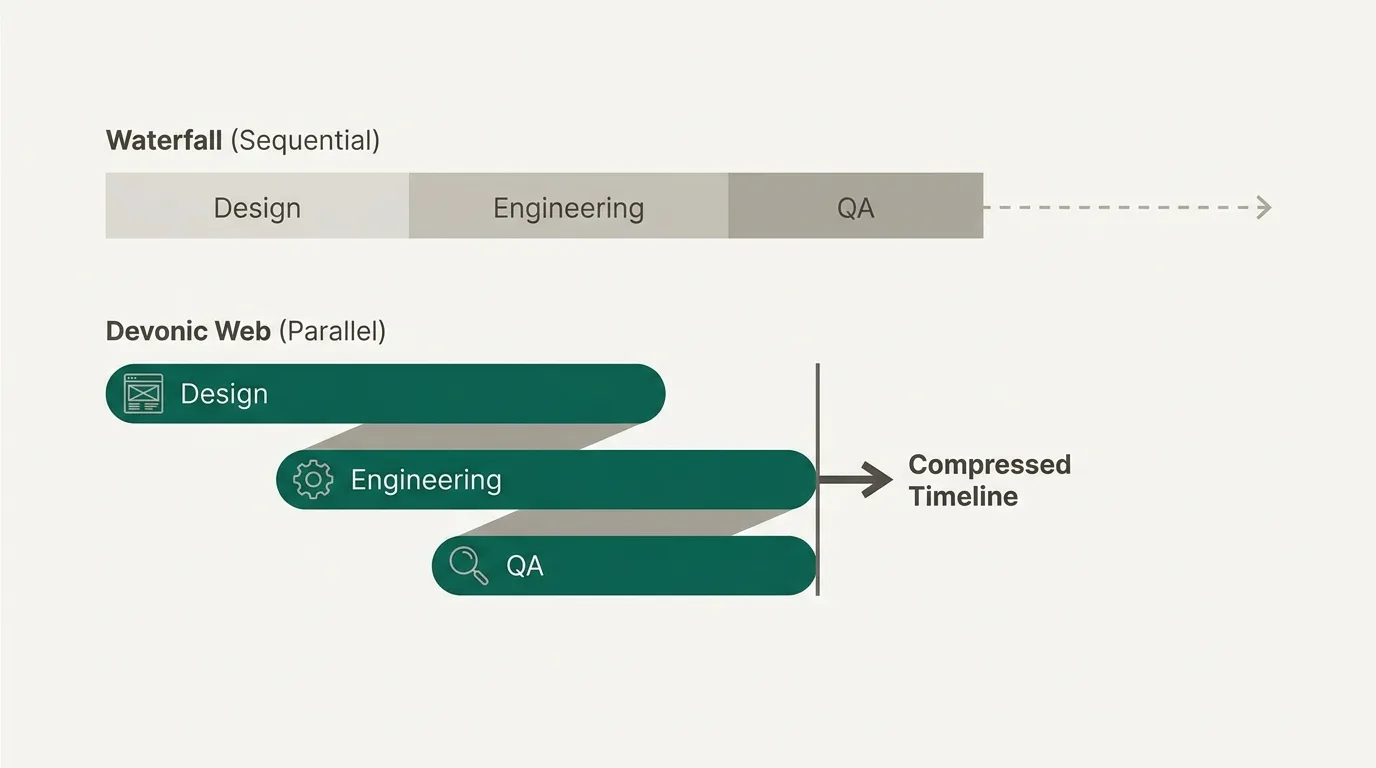
Sequential work stretches timelines badly. Design finishes, then engineering starts, then QA runs at the end: that pattern adds four to eight weeks to the same scope. Parallel workstreams compress it. Design runs a week ahead of engineering, engineering builds against agreed flows while design finalises secondary states, and QA runs continuously. This is the mechanism that makes the eight-week target real, not a nice-to-have.
A working shape
Week 1: design leads, engineering scaffolds the stack. Week 2: engineering starts on the core loop while design moves to secondary flows. Weeks 3 to 6: build against a locked scope with a weekly demo. Weeks 7 to 8: harden, instrument, private launch.
Stack choice as a timeline lever
Every exotic technology choice adds weeks. Choosing an opinionated, well-understood stack is one of the highest-leverage decisions you make at this stage. Next.js, TypeScript, Postgres, a hosted auth provider, a hosted payments provider, deployed on a mainstream platform: this shape supports the eight-week timeline because none of it needs building from scratch.
The moment you decide to write your own auth, build a bespoke deployment pipeline or pick a database you have never run in production, you have added weeks. Sometimes that is the right call. At MVP stage, it almost never is. Our post on build vs buy: when custom software beats off-the-shelf covers the decision framework in more detail.
Get plain-English guides like this in your inbox.
One short email a month. WordPress, Shopify, SEO, no fluff. Unsubscribe in one click.
We never share your email.
What to cut and what you must never cut
Cut complexity, not the core. The list of things to cut on a first release is longer than most founders want to hear:
- Self-serve onboarding. Onboard the first fifty users manually. A fifteen-minute call teaches you more than a signup funnel.
- Custom UI kits. Use a standard component library. Nobody will churn over your button radius.
- In-app notifications. Send emails. Add in-app later.
- Multi-language support. Launch in one language. Localise when demand is proven.
- Admin dashboards. Query the database directly for the first month.
- Role-based permissions beyond two roles. Owner and member is enough.
- Advanced filters and search. A list and a keyword search will do.
What you never cut: security, stability and the interaction that makes the product worth using. A buggy MVP destroys trust in a way that is hard to recover from. If your users cannot experience the core value without an explanation, you have gone past minimum into confusing.
Instagram famously started as Burbn, an app crammed with location features. It only worked once the team stripped everything except photo sharing. The lesson is not "cut more". It is "protect the one thing that matters".
Non-functional work is the category founders forget. Performance budgets, security hardening, monitoring, error tracking and backups all take real time. Price them into the scope from the start. Treated as optional extras, they become the reason the launch slips.
Instrumentation and success criteria before you write a line of code
An MVP that ships without analytics is an opinion with a login screen. Wire up product analytics, error tracking and a lightweight event schema on day one. You need to know what users did, not what you hoped they would do.
Define your success thresholds before launch, not after. "If 40% of new users complete the core action within 48 hours, we've validated demand." "If activation stays under 15%, we pivot the onboarding." Pre-defined bars stop you moving the goalposts when the numbers come in. Without them, every result feels ambiguous and the temptation is to keep building instead of deciding.
We do this in the scoping session. It is part of the definition of done. If you are thinking about how instrumentation and simple AI features fit together for a lean product, our piece on adding AI features to your product without the hype is worth a read.
If you want a partner to run this end to end, our custom software and SaaS development practice is built around this exact shape: fixed scope, weekly delivery, real users inside eight to twelve weeks.
The five scoping mistakes that kill MVPs
After enough of these projects, the failure modes repeat.
- Feature overload. Trying to please every stakeholder. A product for everyone is a product for no one. Feature bloat extends timelines by 40 to 60% in most studies, and the extra features usually go unused.
- Skipping validation. Building the whole thing before talking to a single user. Ten interviews before scoping saves weeks of building the wrong feature.
- Gold-plating. Spending three weeks on a button animation while the core logic is still buggy. Polish comes after proof.
- HiPPO decisions. The Highest Paid Person's Opinion overriding user data. Write down who has decision rights on scope changes before the build starts.
- Opaque requirements. "Make it fast." "Make it modern." Vague requirements produce vague products. Write measurable criteria: page load under two seconds, task completion in under four clicks.
The common thread is avoidance. Cutting scope is a hard conversation, so teams delay it. The delay costs weeks, and the weeks cost market feedback you cannot recover.
One test before you build
Read your scope back and ask: which single feature would break the core value loop if removed? If more than three features pass that test, the loop is not yet defined tightly enough.
Scoping is not a phase you complete and move past. It is a discipline you hold every week of the build. The teams that ship in eight weeks are not faster coders. They are better at saying no. If you'd like to see how we scope and ship products, our case studies show the shape of what fits in that window and what does not.