Why Most Content Marketing Strategies Will Fail in 2026 (and How Yours Won’t)
In 2026, “publish more” is not a strategy, it is a slow leak of time, budget, and credibility. Search results are increasingly answer-driven, social platforms reward creators over companies, and buyers trust peers and practitioners more than polished brand messaging. If your plan depends on flooding the internet with posts and hoping Google sends traffic, you will feel the decline before you can explain it.
Attention is fragmented, distribution matters as much as production, and the content that wins looks more like a product than a campaign. The good news is that you do not need 10x more assets. You need fewer, higher-leverage assets that compound through smart packaging, proof, and repeatable distribution.
Here’s a quick self-audit that cuts through the noise: if you stopped publishing for 30 days, would leads drop to zero? If yes, you are running a treadmill, not building an engine. The goal for 2026 is an AI-resilient content marketing strategy that keeps working even when algorithms shift, because it is anchored to trust, evidence, and a system you can measure.
Start With Strategy, Not Content: Goals, Audience, and Positioning for 2026
Define outcomes that matter, not vanity metrics
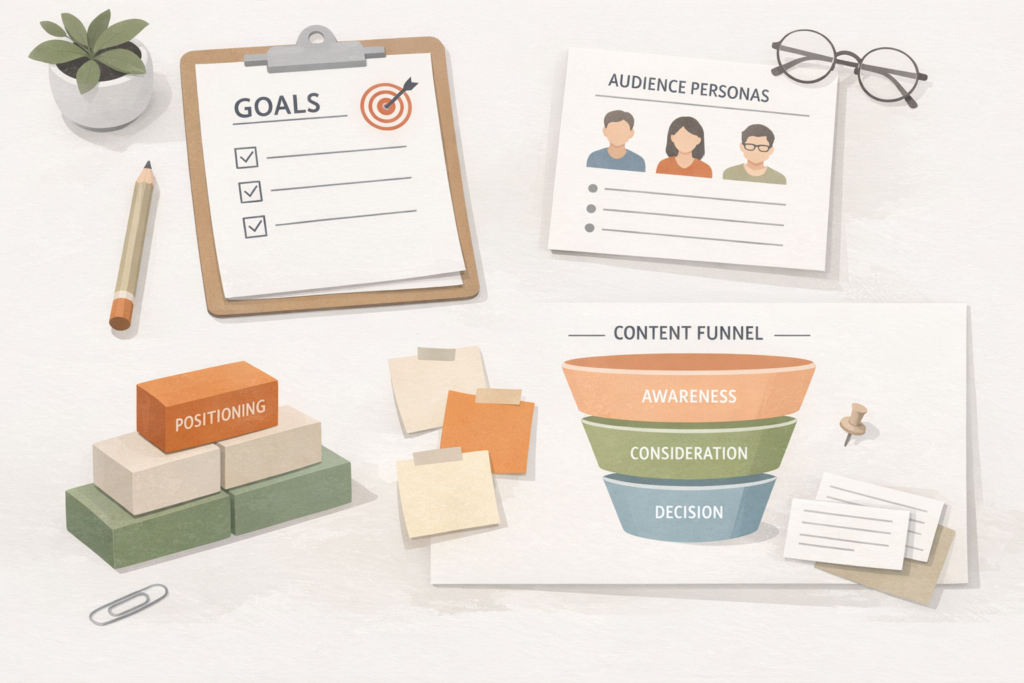
Start by tying content to how revenue actually happens in your business. Map your funnel stages from awareness to consideration to conversion to retention, then decide what content needs to accomplish at each step. Views and impressions can be useful diagnostics, but they are not outcomes.
Pick one or two primary goals so your team can make tradeoffs without arguing. A clean example looks like this: increase qualified demo requests by 25% in two quarters via bottom-of-funnel content plus retargeting. That statement implies what you will create, who it is for, and how you will distribute it.
Build a 2026-ready audience model
Personas are fine, but jobs-to-be-done are better. Document what your audience is trying to accomplish, what is blocking them, and what makes them trust an answer. In 2026, trust triggers matter as much as pain points, think benchmarks, peer stories, screenshots, and specific implementation details.
Then map channels by intent. Search often captures problem-aware buyers who want a clear next step. LinkedIn tends to reward insight and a strong point of view. Email is where relationships compound, because you can reach people without paying rent to an algorithm.
- Audience card mini-template: role, job to be done, top 3 objections, decision criteria, preferred formats
- Trust triggers: proof points, customer quotes, before-and-after examples, numbers with context
Clarify your “why you” positioning
If your content sounds like everyone else’s, AI will happily replace it, and buyers will ignore it. A simple positioning move is to state what you believe that competitors do not, and back it with evidence. For example, you might believe that “content distribution is a product,” then prove it by showing your repeatable workflow, performance benchmarks, and how it ties to pipeline.
The 2026 Content Strategy Framework: Topics, Formats, and a Publishing System
Build a topic architecture that’s hard to copy
Keyword lists are easy to copy, a topic architecture built on your experience is not. Organize your content into three buckets that work together. Pillars are evergreen guides that define your core themes. Proof content demonstrates results through case studies, data, and teardown-style examples. Pulse content reacts to timely shifts, like new platform changes or buyer behavior patterns.
Within each pillar, build topic clusters so you own a theme instead of chasing isolated keywords. A practical cluster could center on “content marketing strategy,” supported by posts like a content audit checklist, an editorial calendar template, and an AI content QA process. The cluster approach helps humans navigate and helps search systems understand authority.
Choose formats that match how people learn in 2026
Buyers do not all learn the same way, and they rarely consume content in a straight line. Plan your formats intentionally, then repurpose with purpose, not copy-paste. One pillar page can become a newsletter issue, a set of short video scripts, a sales enablement one-pager, and a webinar outline, but only if you adapt the message to the context.
- High-leverage formats: deep guides, comparison pages, templates and tools, webinars, creator collaborations
- Repurposing map example: 1 research report, 8 LinkedIn posts, 2 email sequences, 1 webinar, 1 landing page
Create a sustainable cadence
Consistency beats intensity, especially when distribution is part of the workload. Set a cadence your team can sustain for six months, not two weeks. If you can publish one excellent pillar per month and ship proof and pulse content weekly, that is often stronger than daily posts that nobody remembers.
Build for Discovery in a Zero-Click World: SEO + Social + Community
SEO in 2026: optimize for humans, machines, and credibility
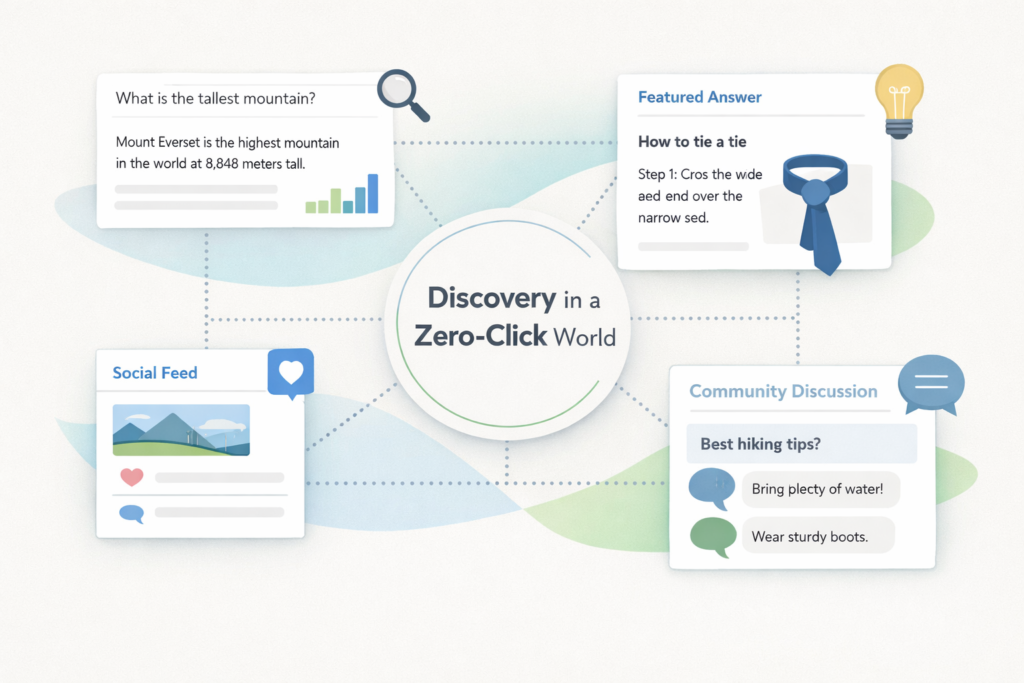
Zero-click search is real, and it is not going away. Your job is to make your pages easy to extract, while still worth clicking. That means clear structure, direct answers, and credibility signals that AI summaries cannot fake.
- On-page checklist: definition block, TL;DR, FAQ section, proof section, internal links to the cluster
- Evidence upgrades: first-party data, expert quotes, real screenshots, step-by-step workflows
Write like you expect skepticism. Add comparison tables, show tradeoffs, and include “when this will not work” notes. Those details build trust and differentiate you from generic content that reads like it was assembled from other articles.
Social distribution as a core part of the strategy
In 2026, social platforms reward clarity and point of view. Build a repeatable content-to-post system so distribution does not depend on inspiration. Pull hooks from objections you hear on calls, lead with a contrarian insight, then earn attention with a mini case study or a simple framework.
One practical pattern is to turn a pillar section into a five-post thread: the problem, the myth, your framework, a real example, then a call to action that points to a template or checklist on your site. Creator and partner collaborations also matter more than ever, because they let you borrow trust and reach from people your audience already listens to.
Community and email as moat channels
Search and social are discovery channels, but email and community are compounding channels. Give visitors a reason to subscribe that matches the job they are trying to do, like templates, calculators, swipe files, or implementation checklists. Then keep the relationship warm with feedback loops, polls, office hours, and live Q&A sessions that surface real questions for future content.
Get plain-English guides like this in your inbox.
One short email a month. WordPress, Shopify, SEO, no fluff. Unsubscribe in one click.
We never share your email.
AI in Content Strategy 2026: Use It for Leverage Without Losing Trust
Where AI helps most, and where it hurts
AI is excellent at speeding up the parts of content work that are repetitive or structural. Use it for research synthesis, outlining, repurposing, content refreshes, metadata, and localization. It can also help you find patterns across customer conversations faster than a human can.
Where AI hurts is where trust is on the line. Generic thought leadership, unverified claims, and “same-as-everyone” SEO pages are risk zones. If your content sounds plausible but lacks proof, buyers will bounce, and your brand will pay the credibility tax later.
Create a quality control system
AI-resilient teams run on standards, not vibes. Define editorial requirements for accuracy, tone, differentiation, and compliance. Add proof requirements so every meaningful claim is supported by a source, a screenshot, a customer quote, or your own data.
- QA checklist: fact-check key claims, validate links, run a plagiarism scan, confirm screenshots are current, ask “what’s truly new here?”
Build a human + AI workflow
Clear roles prevent AI from becoming a content crutch. A simple workflow is strategist sets the angle and goal, a subject matter expert adds real-world detail, a writer drafts and shapes the narrative, an editor tightens and verifies, and a distribution owner packages it for search, social, and email.
- Prompt example: “Summarize these 10 customer calls into top objections and exact phrases, output grouped by funnel stage, include frequency and suggested content angles.”
Measure What Matters: KPIs, Attribution, and a 90-Day Optimization Loop
Pick KPIs by funnel stage, and stick to them
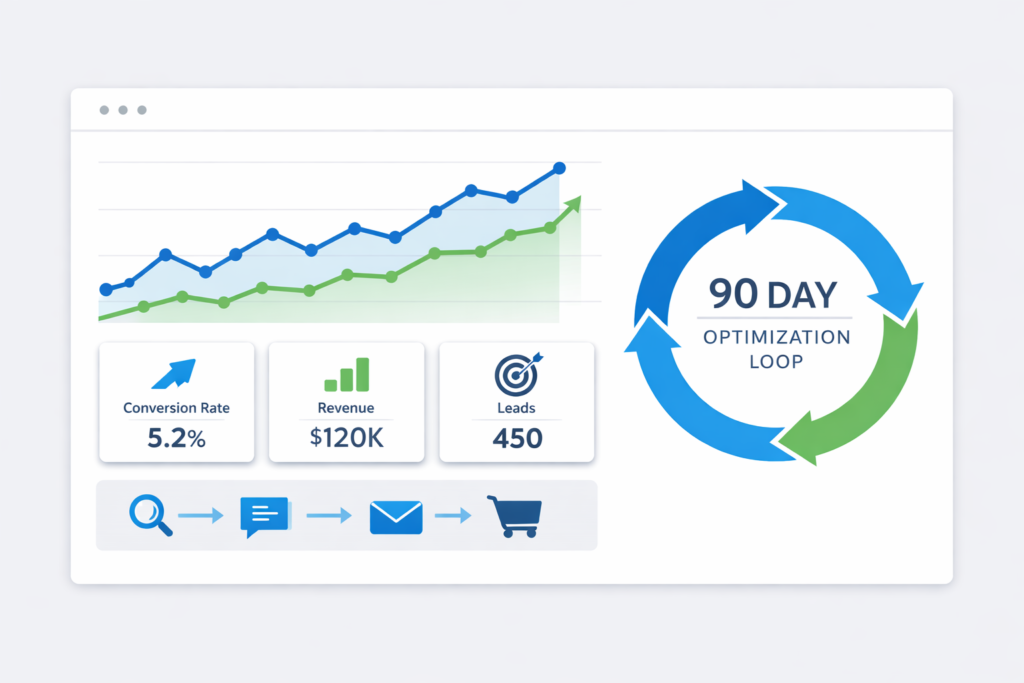
Measurement gets messy when every piece of content is expected to do everything. Assign KPIs by stage. For top-of-funnel, track qualified traffic, subscriber growth, and engaged time. For middle-of-funnel, watch email click-through rates, webinar sign-ups, and product page assists. For bottom-of-funnel, focus on demo requests, sales-qualified leads, and influenced revenue.
Set up measurement without overcomplication
You do not need a complicated attribution model to make better decisions. Use consistent UTM conventions, group content by pillar and cluster, and build a simple dashboard your team actually checks. Define success thresholds so you know what to update, what to scale, and what to kill.
- Simple dashboard view: top 10 pages by assisted conversions, top 10 pages by subscriber conversions
- Decision rules: refresh winners quarterly, merge overlapping posts, prune content with no engagement after redistribution
Run a 90-day content improvement cycle
Every 90 days, audit performance, optimize what is close to winning, redistribute what deserves another shot, and refresh content that is aging. This is where compounding happens. A strong optimization play is to refresh older posts with new examples, add comparison tables, improve internal linking across the cluster, then relaunch through email and social as if it is new.
Your 2026 Content Marketing Strategy Checklist (Actionable Takeaways)
A 2026-ready content marketing strategy is not built on volume, it is built on leverage and trust. Anchor on outcomes that map to pipeline, and build an audience model based on jobs-to-be-done and real objections. Create a defensible topic architecture with pillars, proof, and pulse, then treat distribution as part of creation, not an afterthought.
Use AI to move faster, but keep humans responsible for accuracy, differentiation, and evidence. Finally, measure by funnel impact, and commit to a 90-day loop that audits, optimizes, redistributes, and refreshes. That is how you stop running the treadmill and start building an engine that keeps working even when the platforms change.
- Draft a one-page strategy with goals, audience, positioning, channels, and KPIs
- Choose one pillar topic and outline six supporting cluster posts that answer real objections
- Create one practical lead magnet, like a checklist or template, to turn visitors into subscribers