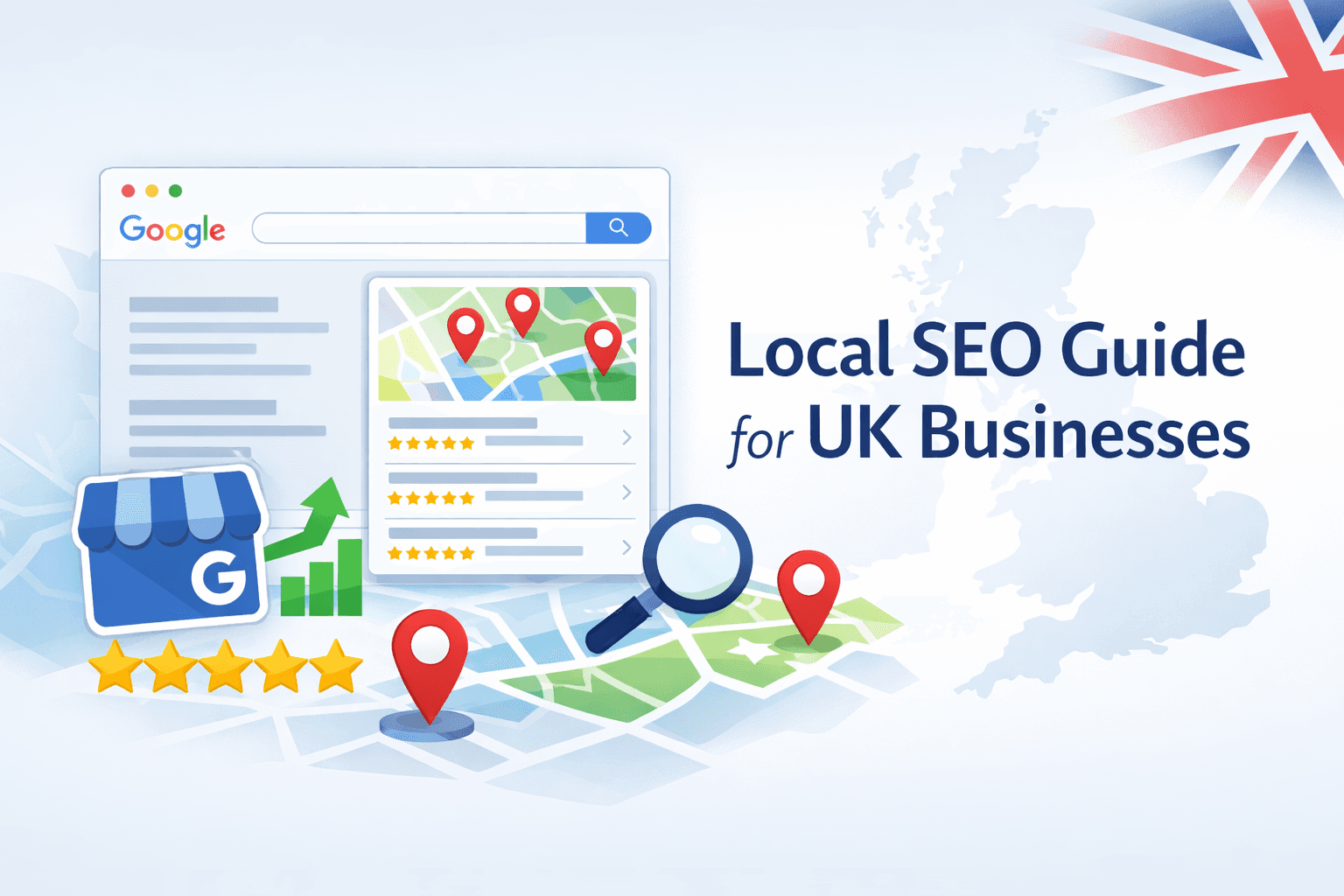
Intro (Hook): Why UK businesses are losing local customers (and how to stop it fast)
Local customers are not “finding you on Google” anymore, they are choosing you on Google. When someone searches “plumber Leeds” or “electrician near me”, the first real decision happens in the Local Pack, the map results with three businesses, reviews, call buttons, and directions. If you are not in that box, you are invisible at the exact moment people are ready to book.
This guide gives you a practical UK local SEO strategy that improves Google Maps visibility and lifts local organic rankings at the same time. No theory for theory’s sake, just the levers that actually move calls, enquiries, and footfall.
Quick self-check
- Do you appear for “service + town” searches, for example “plumber Leeds”?
- Is your Google Business Profile complete, verified, and active?
- Is your NAP, your name, address, and phone number, consistent everywhere online?
Picture two Bristol electricians. Both do great work. One has a half-finished profile, five old reviews, and no recent photos, so Google shows competitors instead. The other has the right category, clear services, weekly updates, and 30+ recent reviews, so they show up in the Local Pack and get calls without the customer ever visiting a website. The difference is not quality, it is visibility.
Local SEO is won off your website
The biggest local ranking levers, Google Business Profile, reviews, and proximity, sit outside your site entirely. Get those right before pouring effort into on-page work.
How local search works in the UK (and what Google actually rewards)
Google’s local algorithm is brutally practical. It tries to show the best match, closest to the searcher, with enough proof that the business is real and trusted. In the UK, where towns blend into suburbs and boroughs, small improvements to relevance and prominence can beat bigger brands that look generic.
The three local ranking factors
- Relevance, how well your business and pages match the query.
- Distance, how close you are to the searcher, or to the location implied in the search.
- Prominence, how well known and trusted you appear, based on reviews, citations, links, and brand signals.
Local Pack vs. local organic results
The Local Pack drives immediate actions, calls, direction requests, and quick bookings. Local organic results matter when people compare options, research prices, or want a specialist, and they still feed prominence because strong content and links build authority. In practice, you want both, but you optimise for the Local Pack first because that is where high-intent customers click.
UK search intent patterns worth targeting
- “Service + town/city”, for example “accountant Manchester”.
- “Best + service + area”, for example “best conveyancing solicitor Watford”.
- “Emergency/24-hour + service”, for example “24 hour locksmith Glasgow”.
Keyword mapping example
- “boiler repair Nottingham” → core boiler repair service page.
- “boiler repair West Bridgford” → location page, only if you genuinely serve that area and can add proof.
- “boiler service cost Nottingham” → FAQ or blog post that supports the service page and answers pricing questions.
Google Business Profile (GBP) optimisation that moves the needle
Your Google Business Profile is your shopfront in the Local Pack. In many UK trades and services, it converts better than the website because the customer can call in one tap. Treat it like a living sales asset, not a directory listing.
Set up and structure for maximum relevance
- Pick the best primary category, this carries the most weight. Do not choose a vague category if a specific one exists.
- Add a few accurate secondary categories that reflect real services, not wishful thinking.
- Write a UK-focused description that names your core services, your genuine service areas, and trust signals such as years trading, accreditations, or guarantees.
Turn GBP into a conversion asset
- Add services or products with clear names and short descriptions that match what people search.
- Use attributes that matter, for example “online estimates” or “wheelchair accessible”, if true.
- Link to booking or enquiry pages, and consider messaging if you can respond quickly.
- Post weekly updates, even short ones, such as seasonal callouts, recent jobs, or limited-time offers.
Photos, Q&A, and spam-fighting
- Upload real photos, team, vans, premises, and completed work. Rename files sensibly before upload, for example “kitchen-installation-bristol.jpg”.
- Seed and answer common questions, parking, service areas, response times, and how you price jobs.
- Report spam listings that keyword-stuff names, for example “Best Plumber Leeds 24/7”, because they can push you out of the pack.
GBP checklist
- Primary and secondary categories set correctly
- Services added and aligned to real offerings
- Hours accurate, including bank holidays
- Service areas set realistically, not the whole of the UK
- Booking URL added
- UTM tracking link used on the website field to measure GBP traffic
Example GBP description (UK service business)
We are a Bristol-based electrical team providing domestic and commercial work across Bristol, Bath, and the surrounding areas. Our electricians handle fault finding, consumer unit upgrades, EICRs, lighting installs, and emergency callouts, with clear pricing and tidy workmanship. We are fully insured, qualified to current UK standards, and we turn up when we say we will. If you need a fast response for a tripping fuse board, or you want a quote for a rewire, contact us for straightforward advice and an appointment that suits your schedule.
On-site local SEO essentials (pages, content, and trust signals)

Your website supports local rankings by proving relevance and building trust. A strong GBP can get you into the pack, but your site often seals the decision when customers compare reviews, pricing, and credibility.
Build pages that match how people search locally
- Create core service pages that clearly explain what you do, who it is for, and what happens next.
- Add location targeting only where you genuinely operate, and only where you can add specifics, not generic text.
- Avoid thin “cookie-cutter” town pages. If you build a page for a place, include proof such as local case studies, photos from that area, or common local property types you work with.
On-page optimisation that supports local rankings
- Use “service + location” naturally in title tags and H1s, and keep it readable.
- Add local proof, testimonials that mention areas, short case studies, and a project gallery with captions.
- Make it easy to contact you, phone number visible, fast-loading pages, and clear next steps.
Sample title tag formulas
- Emergency Plumber in Sheffield | 24/7 Callouts – Brand
- Boiler Repair Nottingham | Same-Week Appointments – Brand
- Accountant Manchester | Tax Returns and Payroll – Brand
Schema and contact details for UK businesses
- Add LocalBusiness schema with NAP, opening hours, and service area.
- Put NAP in the footer and create a dedicated contact page with an embedded map and clear directions.
Local trust block template
- Accreditations and memberships relevant to your trade
- Insurance level and what it covers
- Typical response time and operating hours
- Areas served, written plainly
- Review badges or embedded review snippets, used honestly and consistently
Get plain-English guides like this in your inbox.
One short email a month. WordPress, Shopify, SEO, no fluff. Unsubscribe in one click.
We never share your email.
Citations, reviews, and reputation: the UK local authority engine
If your business details are messy online, Google hesitates. If your reviews are stale, customers hesitate. In competitive UK markets, consistent citations and a steady flow of reviews are often the difference between position four and the Local Pack.
Citations and NAP consistency
- Audit your business name, address formatting, and phone number across the web, then fix mismatches.
- Prioritise key UK sources such as Yell, Thomson Local, Scoot, FreeIndex, Yelp UK, Apple Business Connect, and Bing Places.
Reviews strategy that works
- Ask after every job or sale, while the experience is fresh.
- Aim for quantity, quality, and recency. Ten reviews from three years ago will not compete with ten reviews from the last two months.
- Respond to every review, and naturally mention the service and area without forcing it.
Copy-paste review request template
Hi [Name], thanks again for choosing us for [job/service] in [area]. If you have 30 seconds, would you mind leaving a quick Google review? It really helps local customers find a reliable [trade/service]. Here’s the link: [link]. Thanks, [Your Name]
Review response template
Thanks for the review, [Name]. We’re glad we could help with [specific work] at your property in [area]. If you ever need advice on [related service], feel free to get in touch, we’re always happy to help.
Reputation beyond Google
- Where relevant, build reviews on platforms UK customers trust, such as Checkatrade or TrustATrader.
- Showcase reviews on your website in a compliant way, and keep them up to date.
Local links and community signals (the differentiator in competitive UK markets)

Links are still a strong signal of prominence, and local links carry extra weight because they reinforce geographic relevance. The good news is you do not need national press, you need genuine community connections.
Earn local backlinks that are realistic for SMEs
- Sponsor a youth sports club, charity event, or local fundraiser, and ask for a link on the sponsor page.
- Create partnerships with suppliers and complementary businesses, then add “recommended partner” pages that link both ways.
Digital PR for local relevance
- Pitch local newspapers and blogs with a useful story, such as seasonal safety tips backed by your own data.
- Publish a local resource worth linking to, for example “Homeowner maintenance checklist for Leeds winters”.
Avoid risky tactics
- Do not buy spammy links, they rarely help long-term and can create problems later.
- Do not create fake location pages for places you do not serve, customers notice and Google catches up.
Outreach email template
Hi [Name], I’m [Your Name] from [Business] in [Town]. We’re supporting local organisations this year and I noticed your [club/charity/event]. If we sponsor [specific item], would you be able to include us on your sponsors page with a link to our site? Happy to send our logo and a short description. Thanks, [Name], and good luck with the season.
Local link opportunities list
- Local chambers of commerce member directories
- BID associations and town centre partnerships
- Local universities and colleges supplier pages
- Community event listings and local charity partners pages
Conclusion (Actionable takeaways): Your 30-day UK local SEO strategy
Local SEO is not a mystery, it is a system. Execute the basics consistently, then stack small advantages until Google and customers both trust you more than the next option.
Week 1: Fix foundations
- Update GBP categories, services, photos, and hours, including bank holidays
- Run a NAP consistency audit and correct the worst mismatches first
Week 2: Improve your website for local intent
- Upgrade your key service pages with clearer copy, proof, and internal links
- Strengthen your contact page, add an embedded map and full NAP
- Add LocalBusiness schema
Week 3: Build authority
- Submit or clean up top UK citations
- Start a steady review request process, then respond to every review
Week 4: Differentiate with local links and content
- Secure 1 to 3 local backlinks through sponsorships, partners, or community pages
- Publish one locally relevant piece of content that answers a real question customers ask
If you keep the fundamentals tight, GBP excellence, on-site relevance, reviews and citations, and a few real local links, you can compete for the Local Pack even in crowded UK markets. Own your postcode, and you stop relying on luck for local customers.