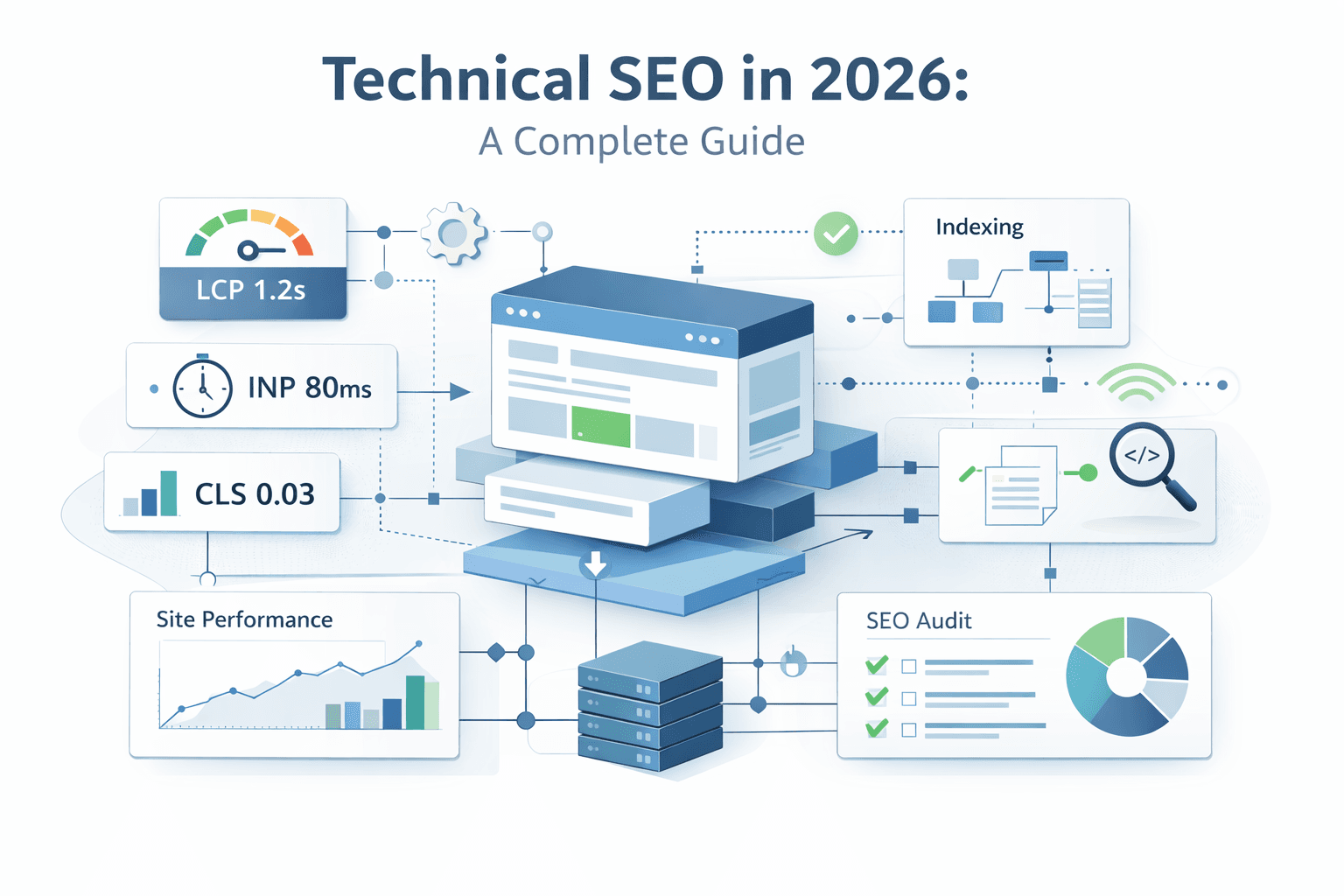
Why Technical SEO in 2026 Is a Make-or-Break Ranking Factor (Read This Before You Audit)
If your rankings feel capped, even though your content is solid and your backlinks are fine, you are probably fighting an invisible ceiling. In 2026, that ceiling is usually technical. Google can only rank what it can efficiently crawl, render, understand, and trust enough to keep indexed.
Two big shifts from 2025 to 2026 changed the game. AI-driven SERPs reward clean entity signals and structured data more often, and Google expects sites to waste less crawl on junk URLs. If your site generates endless parameters, thin filters, and duplicate templates, you are spending crawl budget on pages that will never win.
Google can only rank what it can efficiently crawl, render, understand, and trust enough to keep indexed.
How to tell if technical issues are the bottleneck
- Pages you care about are not indexed, especially category, service, or hub pages.
- Traffic plateaus for months, then spikes or drops after minor site changes.
- GSC shows growing counts of “Discovered, currently not indexed” or “Crawled, currently not indexed.”
5-minute triage before you do anything else
- Run site:yourdomain.com and compare the rough index footprint to how many real, valuable URLs you actually have.
- In Google Search Console, compare “Indexed” vs “Submitted” in your sitemaps.
- Red flag: if your category pages are not indexed, your SEO will not scale, because those pages usually carry internal links and demand capture.
Start with the index, not the checklist
Before touching anything, confirm what Google actually has indexed versus what you submitted. Most "technical SEO" projects are really one fix, stopping crawl waste on URLs that were never going to rank, and you can only see that gap from the index data, not from a tool score.
Crawlability & Indexability: Get Google to Find the Right Pages (Not the Wrong Ones)
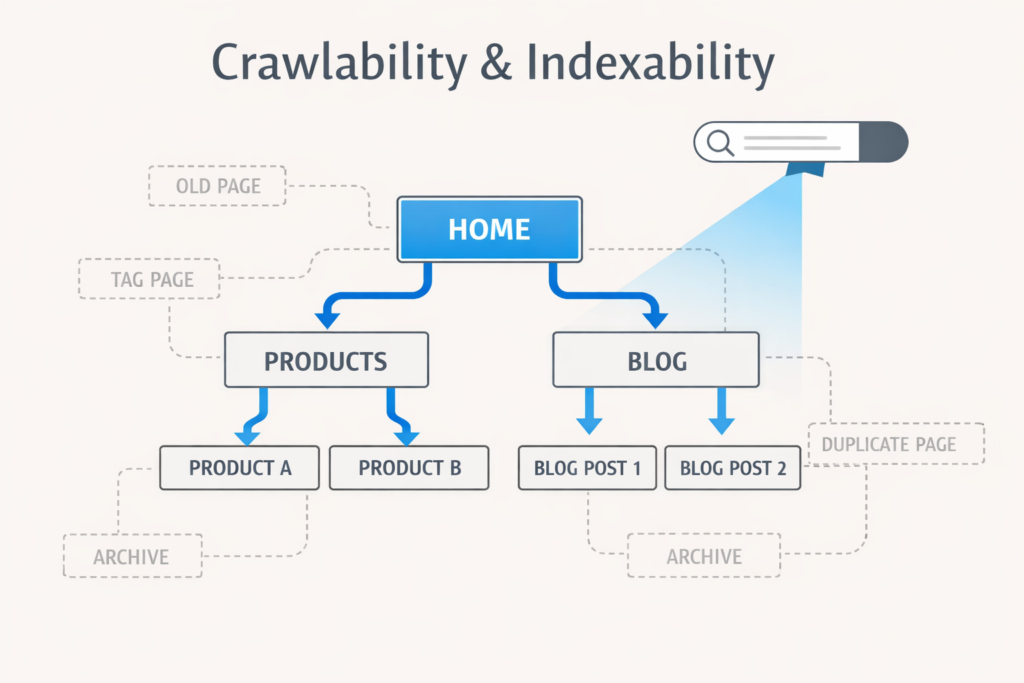
Most technical SEO wins come from one idea, reduce waste. You want Googlebot spending time on pages that deserve to rank, not on internal search results, infinite filters, and near-duplicates created by parameters.
Crawl budget and crawl efficiency
Crawl budget is not just for giant sites anymore. Any site with faceted navigation, sort options, tracking parameters, or user-generated pages can accidentally create tens of thousands of crawlable URLs. That bloats logs, slows discovery of important pages, and increases the odds Google gives up before it reaches your deeper content.
- Limit crawl paths for faceted URLs, especially combinations like?color=blue&size=m&sort=price
- Keep internal links pointed at clean, primary URLs, not parameterized versions.
- Remove thin pages from the crawl path, do not just hope Google ignores them.
Robots.txt vs meta robots vs canonicals
These tools do different jobs, and mixing them up causes index chaos. Use robots.txt to control crawling, meta robots to control indexing, and canonicals to consolidate signals between similar pages.
- Use noindex,follow for internal search results and low-value filter pages when you still want link equity to flow through them.
- Canonicalize parameterized URLs back to the primary clean URL, but only when the content is truly a duplicate.
- Validate robots.txt does not block CSS or JS needed for rendering, blocking those can make Google see a broken page.
Sitemaps that work
A sitemap is not a dump of every URL your CMS can output. It is a curated list of index-worthy pages. If you include junk, Google learns to ignore your sitemap, and you lose a reliable discovery channel.
- Split sitemaps by type, for example: categories, products, articles, locations.
- Only include canonical, 200-status, indexable URLs.
- In GSC, review “Pages” for Crawled, currently not indexed and Discovered, currently not indexed and cross-check those patterns against sitemap inclusion.
One practical workflow that saves hours is an “Indexation Map” spreadsheet. List each URL type, decide index or noindex, set the canonical target, and note whether it belongs in the sitemap. That single document prevents teams from undoing your decisions later.
Website Technical SEO Architecture: Build a Site Google (and Users) Can Navigate
Architecture is where technical SEO meets real usability. A clean structure helps Google understand topical clusters, and it helps users move from broad intent to specific answers or products without friction.
Internal linking that actually supports rankings
Relying on a global nav alone is rarely enough. You need hubs, breadcrumbs, and contextual links that reinforce relationships between pages.
- Use breadcrumbs from Category to Subcategory to Product or Article, keep them consistent across templates.
- Add contextual links inside copy, especially from high-authority pages to newer or deeper pages.
- Avoid orphan pages, if a URL has no internal links, it will struggle to get crawled and trusted.
URL structure, taxonomy, and pagination
Stable, readable URLs are still a technical advantage because they reduce duplication and make internal linking cleaner. Faceted navigation is the usual trouble spot, so decide which filters deserve their own indexable landing pages and which should stay non-indexed.
- Keep taxonomy shallow when possible, pages deeper than 4 clicks often underperform.
- Handle pagination with clean links between pages, and avoid creating duplicate category pages via parameters.
- Make sure internal links always point to the preferred URL format, not a mix of variants.
Duplicate content prevention basics
- Enforce one preferred version, HTTPS plus your chosen host (www or non-www), using 301 redirects.
- Standardize trailing slash rules and match them in internal links.
- Use canonicals consistently, and do not canonicalize to pages that return redirects or errors.
A quick, high-signal audit is to run Screaming Frog or Sitebulb, then blend in GA or GSC URL exports to spot orphan URLs. Filter for depth greater than 4, non-200 status codes, and canonical mismatches. Those clusters usually explain why strong content does not rank.
Performance, Core Web Vitals & Mobile: Technical Fixes That Improve Rankings and Conversions
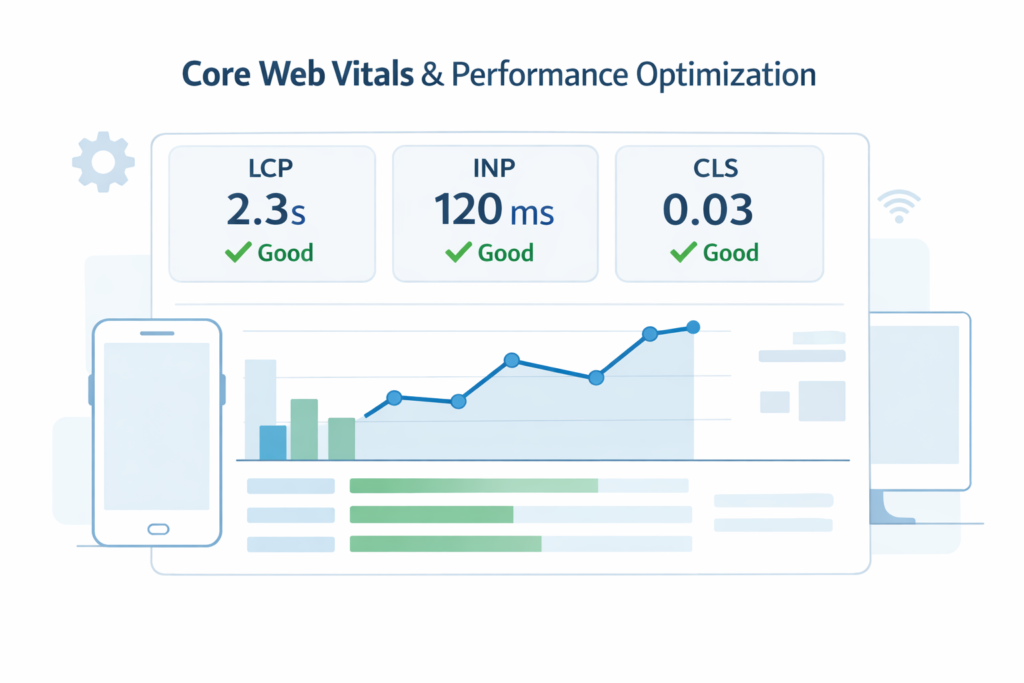
Performance is not just a “nice to have” anymore. In competitive SERPs, speed and responsiveness often decide who wins the click and who keeps it. Core Web Vitals also tend to correlate with better crawl efficiency, because lighter pages are easier to fetch and render.
What matters most in 2026: LCP, INP, CLS
- LCP measures how fast the main content loads, usually a hero image or headline block.
- INP measures how quickly the page responds to user interactions, it is where heavy JavaScript hurts.
- CLS measures layout shift, it is the reason users misclick and bounce.
Practical fixes you can ship
-
Improve LCP: compress and resize hero images, serve AVIF or WebP, preload the key image and critical CSS.
-
Improve INP: reduce long tasks, defer non-critical scripts, split large JS bundles, and remove unused third-party tags.
-
Reduce CLS: reserve space for images and ads, avoid injecting banners above content, usefont-display: swap
and preload key fonts.
Use PageSpeed Insights with CrUX data to see real-user performance, then confirm in Lighthouse or WebPageTest for lab debugging. A common “quick win” is replacing a homepage slider that becomes the LCP element. If you cannot remove it, lazy-load it below the fold and promote a static hero instead.
Mobile-first and JavaScript rendering traps
Mobile is the default crawler perspective, so mobile bugs are SEO bugs. Watch for viewport misconfiguration, tap targets that are too small, and interstitials that block content. On the JS side, make sure critical content and internal links exist in the initial HTML, not only after hydration. If Google has to wait, it may index a thin version of the page.
Get plain-English guides like this in your inbox.
One short email a month. WordPress, Shopify, SEO, no fluff. Unsubscribe in one click.
We never share your email.
Structured Data, Rendering, and SERP Eligibility: Make Your Pages Understandable to Machines
Structured data is no longer just about rich results. It is also how you reduce ambiguity in AI-driven SERPs, especially when your brand, products, or services overlap with similar entities.
Schema that drives results
- Organization and Website schema for brand identity and site-level signals.
- Breadcrumb schema to reinforce hierarchy and improve snippet clarity.
- Product, Offer, and Review for ecommerce, only when reviews are genuine and visible.
- Article for editorial content, including author and publish dates where appropriate.
- FAQ and HowTo only where they match policy and the content is actually present on-page.
Minimum viable schema by site type
- Ecommerce: Product + Offer + Review (if genuine) + Breadcrumb.
- Local service: LocalBusiness + Service + FAQ (when the FAQs are visible and helpful).
Rendering verification and QA
Schema only helps if Google can see it and trust it. Your internal rule should be simple, schema must reflect visible content. If your markup claims five-star ratings but the page shows none, you are inviting invalid items or worse, manual action risk.
- Test with Rich Results Test for eligibility and rendered view.
- Validate in Schema Markup Validator for syntax and structure.
- Monitor GSC Enhancements reports for errors and sudden drops after releases.
The 2026 Technical SEO Checklist + 30/60/90-Day Fix Plan (Do This in Order)
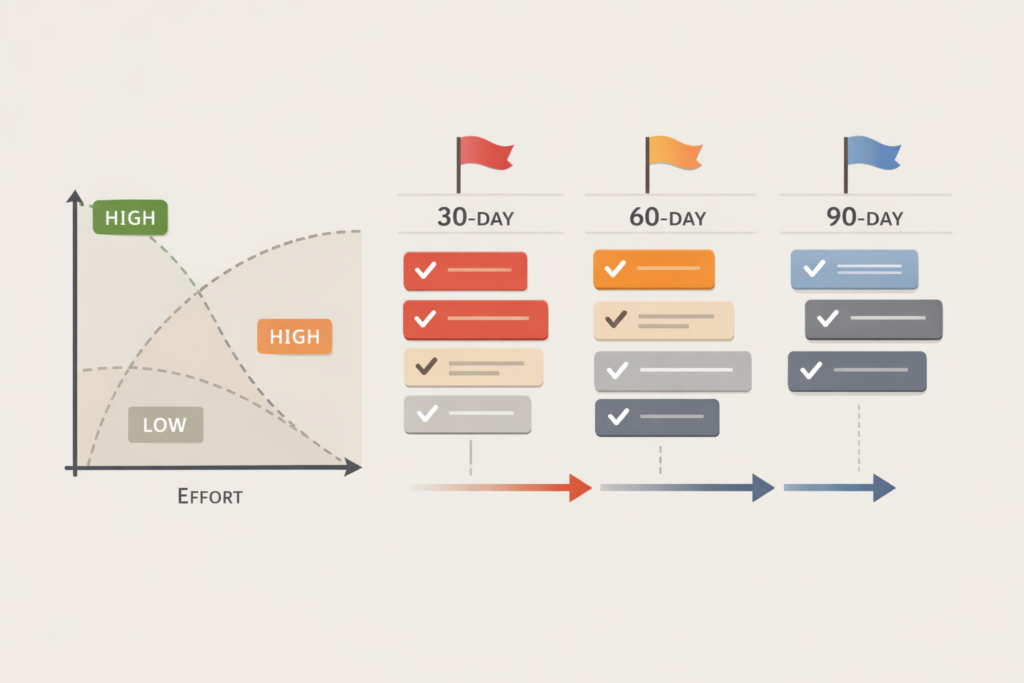
Technical SEO projects fail when teams fix interesting problems instead of impactful ones. Use a simple prioritization framework, Impact times Effort times Risk. Start with changes that unblock indexing and reduce duplication, then move into speed and structured data.
Technical SEO checklist grouped by outcomes
- Indexation health: robots.txt access, meta robots rules, canonical consistency, sitemap quality, redirect hygiene, parameter control.
- Site architecture: internal linking, breadcrumbs, hub pages, orphan cleanup, depth reduction, faceted navigation rules.
- Performance and CWV: LCP image strategy, JS reduction for INP, layout stability for CLS, mobile usability fixes.
- Structured data: minimum viable schema, entity consistency, enhancement monitoring.
- Monitoring: GSC coverage trends, CWV reports, uptime checks, and post-release audits.
30 days: stability and indexation
- Fix robots, canonical, and noindex mistakes, especially on money pages.
- Clean sitemaps, keep only canonical index-worthy URLs.
- Standardize redirects, enforce HTTPS and preferred host, eliminate index bloat from thin URLs.
60 days: performance and architecture
- Ship CWV improvements at the template level, not URL by URL.
- Improve internal linking with hubs, breadcrumbs, and contextual modules.
- Resolve template-driven duplicates, trailing slash inconsistencies, and parameter-based duplication.
90 days: scaling and automation
- Roll out schema across templates, then validate in bulk via GSC enhancements.
- Add log file analysis to see crawl waste in the real world.
- Build monitoring dashboards and a pre-release technical SEO QA checklist for every deploy.
To keep this practical, pick 10 important URLs and validate the full path end-to-end. Can Google crawl them, render key content, index the canonical, and rank the page you actually want shown? If any step breaks, fix that before you publish more content.
Closing Summary (Actionable Takeaways to End the Post)
Use this technical SEO guide to figure out what is really blocking growth, crawl and indexing issues, weak architecture, slow performance, or unclear structured data. Start with the highest-impact website technical SEO fixes first, indexation control, clean canonicals and redirects, and internal linking that eliminates orphan pages.
Then apply the technical SEO checklist with the 30/60/90-day plan so work ships in the right order and does not regress after updates. When technical SEO becomes a system, not a one-time audit, rankings stop feeling fragile and start compounding.