
Why most roadmaps fail before delivery starts
Bain's 2024 research puts the digital transformation failure rate at 88%. BCG and McKinsey both land around 70%. The precise figure matters less than the pattern: the majority of programmes do not deliver what they promised, and the reason is structural, not strategic.
It plays out the same way every time. A leadership team commissions a roadmap. It looks credible in the boardroom, gets funded, then meets delivery reality. Priorities shift, dependencies surface late, key people leave, and within two quarters the document is either quietly ignored or rewritten to match what teams have already done. The gap between strategic intent and delivery is where the investment disappears. With worldwide digital transformation spending projected to reach US$2.58 trillion in 2025 according to Statista, that gap is not an abstract concern.
The fix is not a better template. It is treating the roadmap as a live management system with named owners, review triggers and a prioritisation discipline that survives internal politics.
The five structural failure modes
Before you can build a roadmap that survives, you need to understand what tends to kill one. Across the research, the same five failure modes appear repeatedly.
The translation problem
Strategic roadmaps are written in the language of business outcomes, architecture frameworks and milestones. Delivery happens in the language of code, refactors, API contracts, data models and release trains. When nobody on the programme speaks both fluently, requirements get lost, timelines drift, and the eventual output only loosely resembles the plan.
The role that fixes this is usually a technical delivery lead or principal engineer with genuine product instincts. Most organisations skip it because it feels like overhead. It is not. It is the single most impactful hire on a transformation programme.
Scope overload and governance breakdown
When leadership defines direction, the instinct is to cover everything at once: operational efficiency, business model reinvention and new digital domains running in parallel. That produces diluted execution and internal confusion. A stronger approach is to pick one dominant path for the current horizon and sequence the others behind it.
Governance is the mechanism that keeps that discipline honest. It is not bureaucracy layered on top of delivery. It is the forum where hard trade-off calls get made when local leaders push pet projects or when a bottleneck needs someone senior to break it. Sparkco's analysis, cited via businessmodelanalyst.com, attributes 58% of digital transformation failures to governance breakdowns versus 22% to technical issues. Treat that ratio as directional rather than precise, but the direction matches what we see on the ground.
Talent and capacity mismatch
A well-constructed strategy often calls for niche skills: advanced data engineering, specialised cloud architecture, modern DevOps practice. Expecting a team optimised for day-to-day operations to absorb that work on top of their existing load is a reliable route to burnout and slipped dates. The roadmap needs to be honest about which capabilities exist internally, which need hiring, and which are better delivered by a partner who has shipped this kind of work before. That build-versus-borrow decision belongs in the plan itself, not in a footnote.
Prioritisation: the decision engine inside the roadmap
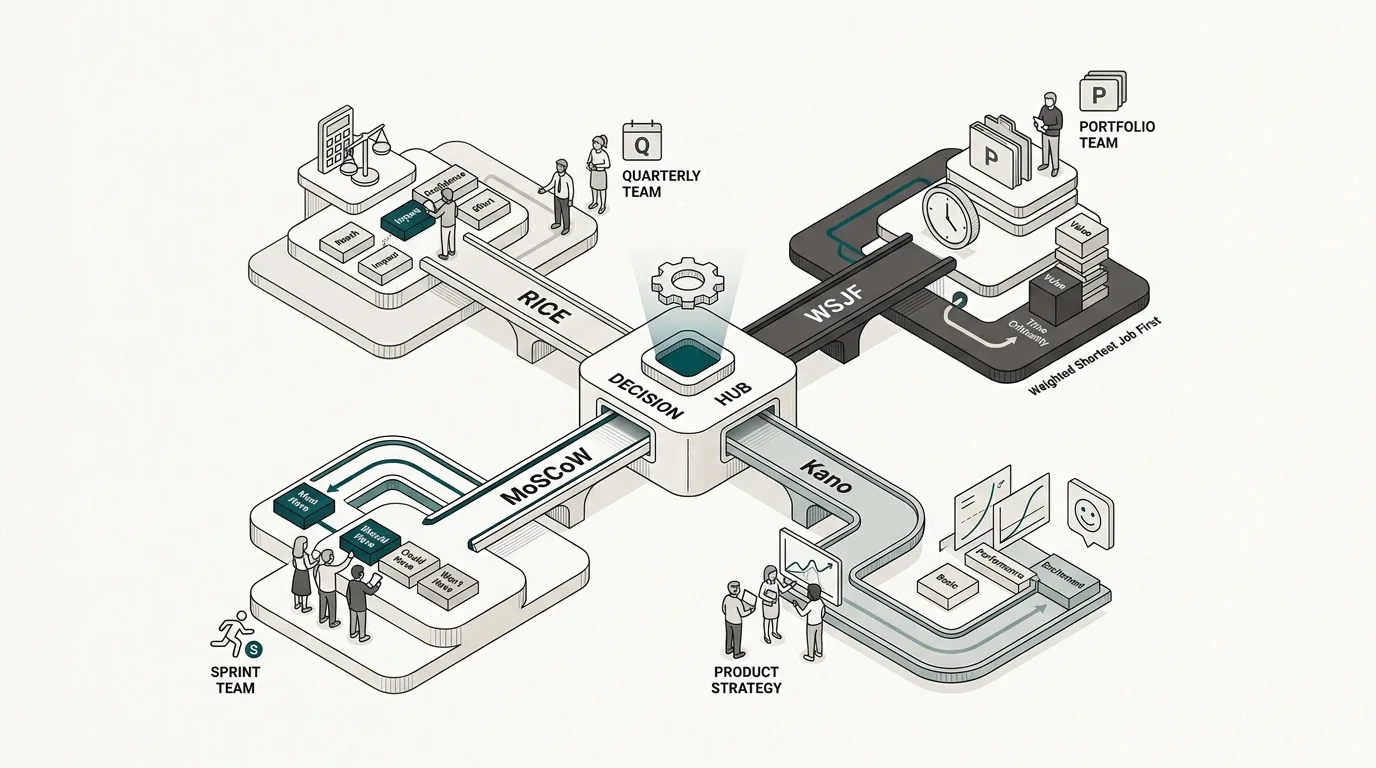
If governance is the operating system, prioritisation is the decision engine. The 2024 State of Product Management Report found that 73% of product teams struggle with feature prioritisation, making it the top operational challenge in product development. McKinsey research shows that less than 20% of product launches meet their full potential, largely due to poor prioritisation. PMI's 2024 report adds that 44% of projects fail due to lack of structured decision-making. The pattern holds at product level and at programme level alike.
Without a systematic method, teams fall into predictable traps: building features because they are easy rather than impactful, chasing competitor functionality without strategic rationale, or letting the loudest stakeholder drive the queue.
Matching the framework to the decision
There is no single best prioritisation framework. There is a best framework for the specific decision in front of you.
- Sprint-level scoping. Use MoSCoW (Must, Should, Could, Won't). It is fast and forces a binary conversation about what actually ships.
- Quarterly roadmap planning. Use RICE (Reach, Impact, Confidence, Effort). The Confidence multiplier is the important part: it stops high-effort, low-evidence bets from dominating the plan because someone senior is enthusiastic about them.
- Portfolio-level trade-offs. Use Cost of Delay or WSJF (Weighted Shortest Job First). These handle initiatives with very different value profiles better than RICE does.
- Customer research and feature satisfaction. Use Kano to separate must-haves from delighters.
The mistake is picking one framework and applying it everywhere. RICE at sprint level is over-engineered. MoSCoW at portfolio level is under-engineered. Match the complexity of the framework to the weight of the decision.
A practical rule
If a prioritisation exercise takes longer than the smallest item you are prioritising, your framework is too heavy for the decision.
The behavioural traps that kill good frameworks
Frameworks only help if you use them honestly. The traps are consistent: the HiPPO effect (highest paid person's opinion wins), recency bias (whatever a customer complained about last week jumps the queue), and effort discounting (small easy wins get overweighted because they feel like progress). The counter is making the scoring visible, keeping the reasoning in writing, and revisiting decisions when the evidence changes. If nobody can explain why item A beat item B, the framework was theatre.
Treating the roadmap as a live management system
A roadmap that survives contact with reality is not a document. It is a management system that connects strategic intent to a practical sequence of decisions across technology, process, talent, data, risk and funding.
Most roadmaps are built to be presented, not executed. The ones that ship look more like an operating manual than a slide deck.
That distinction shows up in three concrete ways: milestones are tied to outcomes rather than outputs, every workstream has a named owner who can make trade-off calls without convening a committee, and the plan is reviewed on both a calendar and a trigger basis. If you want the strategy layer above this to be sharper, our piece on how to run a two-week digital strategy sprint walks through the format we use with clients to get from ambiguity to a defensible plan without months of workshops.
Sequencing over parallelism
The temptation is to run everything in parallel because the strategy calls for it. The evidence says otherwise: pick 5 to 10 lighthouse initiatives for the first 12 to 18 months, weighted between foundational enablers (data platform, cloud migration, identity) and customer-facing initiatives that produce visible wins. Quick wins matter because they sustain executive support, which sustains funding, which sustains everything else.
Sequencing also protects against compounding risk. If your new customer portal depends on the identity migration that depends on the data platform, running them concurrently means every slip cascades. Stagger the starts and the whole programme becomes more forgiving.
Review triggers that go beyond the calendar
Quarterly reviews are necessary but not sufficient. Define trigger-based reviews alongside the calendar ones: a missed milestone by more than one sprint, a competitor launch in your category, a shift beyond a defined threshold in a key business metric, or a change in a critical dependency. When a trigger fires, the review is not optional.
Get plain-English guides like this in your inbox.
One short email a month. WordPress, Shopify, SEO, no fluff. Unsubscribe in one click.
We never share your email.
People and culture: the variable nobody budgets for
Technology rarely fails first. The people and processes around it fail faster. Change management, skills development and internal communications are consistently the first items cut when a programme needs to trim scope, and they are consistently the reason the remaining spend does not deliver.
The pattern is easy to recognise. Employees resist change when they are not involved early. Accountability frameworks are vague, so budget overruns and delays have no owner. Success metrics are aspirational rather than measurable, so nobody can tell whether the programme is working. None of this is soft. All of it is the hard prerequisite for the technical work to matter.
If you are building a business case for a transformation programme, budget for change management as a first-class line item. It is cheaper than the alternative.
AI and execution velocity: the new pressure on planning discipline
AI is compressing the distance between idea and deployment. Some generative AI initiatives are reaching production in as little as 45 days. Google's DORA metrics for 2023 show that elite delivery teams deploy 973 times more frequently than low performers. The gap between what a well-run team can ship and what a poorly-run team can ship has never been wider.
That is a direct problem for roadmaps built on traditional delivery cadence. If your competitor is shipping weekly and you are planning quarterly, your roadmap is out of date the moment it is signed off. It is also a specific problem for AI adoption, because AI features require unusually clear parameters and structured data to function. The rush to add AI capability is exposing weak planning discipline that would have been survivable in a slower environment.
The practical implication: shorter planning horizons, tighter feedback loops, and honest conversations about whether to build in-house or partner. Our note on build vs buy: when custom software beats off-the-shelf covers the decision framework we use for that call. If you are trying to define the minimum viable slice of a new capability, how to scope an MVP that ships in weeks is the companion piece.
This is also where external digital strategy consulting tends to earn its keep: not by producing a bigger deck, but by bringing the sequencing discipline and delivery experience that internal teams often lack when ambition outruns capacity.
What a roadmap that survives delivery actually looks like
Strip away the templates and the workshop artefacts and the roadmap that actually ships has a small number of characteristics in common.
- Outcomes over outputs. Every milestone is tied to a business metric someone can defend. "Launch new checkout" is an output. "Reduce checkout abandonment by X percentage points" is an outcome. Only the second tells you whether to keep going.
- Named owners with authority. Each workstream has one person who can make trade-off calls without a committee. If every decision needs escalation, delivery grinds.
- One dominant path per horizon. Operational efficiency, business model reinvention or new digital domain. Pick one for the next 12 to 18 months and sequence the others behind it.
- A prioritisation framework matched to the decision level. MoSCoW at sprint, RICE at quarter, Cost of Delay at portfolio. Applied consistently, visibly and in writing.
- Trigger-based reviews. Not just quarterly. Defined events that force a re-plan when the world changes.
- A change-management budget that is not the first thing cut. Comms, training and adoption are line items, not afterthoughts.
- A delivery cadence that assumes weekly, not quarterly, shipping. The plan is written in a form that a team can execute against in short cycles.
None of this is exotic. It is the discipline of treating a strategic document as an operating tool rather than a communications exercise. It is also, across the programmes we have worked on, the difference between the 12% that deliver and the 88% that do not.
If you want to see how we approach strategy in practice, the case studies are the honest version: what shipped, what changed, and what the roadmap looked like six months in versus at sign-off. That gap, and how you manage it, is the whole game.