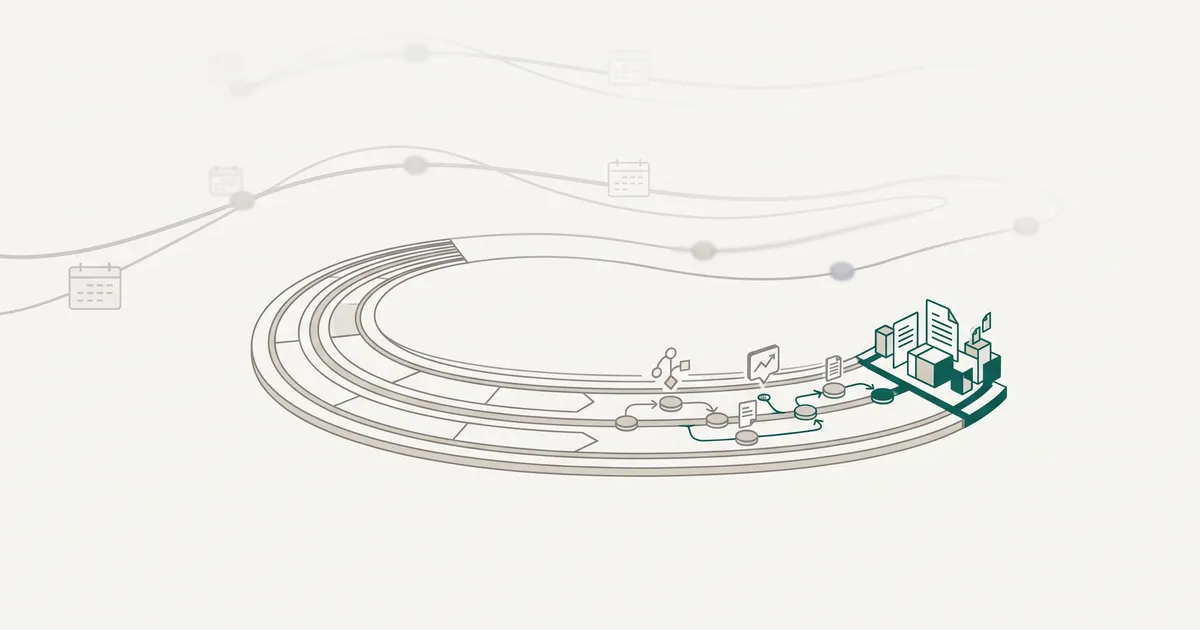
Most digital strategy work takes three months and produces a deck no one references again. A two-week strategy sprint compresses the same deliverables into a format that keeps decision-makers engaged and generates artefacts the team actually uses in standups. This is a practitioner's guide to running one properly, based on how we scope engagements before build work starts.
What a strategy sprint actually is (and what it is not)
A strategy sprint is a time-bound, structured process for making high-level decisions about direction, priorities and investment. It borrows from the Google Ventures design sprint (structured facilitation, forced decisions, working alone together to prevent groupthink) but sits at a different altitude. A GV design sprint validates a specific product idea in five days. An agile delivery sprint ships incremental work in two weeks. A strategy sprint answers the question that comes before both: what should we build, in what order, and why.
It is not a workshop. It is not a discovery phase in disguise. It is not a rebranding exercise. The distinction matters because clients often ask for one and mean another. If the real question is "does this feature work for users", you want a design sprint. If you know what to build and need to ship, you want scoped delivery. A strategy sprint is for entering a new market, evaluating build versus buy, choosing between competing bets, or deciding where a limited amount of engineering effort should land.
A useful test
If you can already write the brief, you do not need a strategy sprint. If two senior people in your org would answer the same question differently, you do.
Why two weeks beats three months
The default enterprise approach to digital transformation is a three-month discovery: stakeholder interviews, current-state assessments, vendor evaluations, strategy documentation, all before anyone writes production code. By the time the roadmap lands, the competitive picture has shifted, the sponsor has moved, and the momentum is gone.
Extended timelines do not produce better strategy. They produce more documentation, more scope creep, and more information decay. Research from IMD's Professor Michael Wade found that 87% of transformation programmes fail to meet expectations, and an Economist survey found that 61% of firms struggle to bridge the gap between strategy formulation and day-to-day implementation. The failure mode is almost never insufficient thoroughness. It is that the strategy arrived too late, or was too disconnected from execution to matter.
Two weeks works because it forces decisions. You cannot spend three days debating a segmentation model when you have ten working days total. The compression is the point.
The goal of a strategy sprint is not to know everything. It is to know enough to make a high-confidence decision about what to build first and how to build it.
Before the sprint starts: the setup work that determines everything
The sprint is only as good as the preparation. We spend roughly a week before day one on three things: framing the problem, mapping the competitive landscape, and locking the room.
Framing the problem. The most common failure mode is stakeholders arriving with a pre-conceived solution. Someone has already decided it is a rebuild, or a new CRM, or an AI feature, and the sprint becomes a retrofit exercise. You surface this with a pre-sprint questionnaire that asks each participant to write, independently, what they think the problem is and what outcome would count as success. If the answers do not agree, that misalignment is the first thing to address on day one.
Competitive and customer input. You need enough context on the market to run informed sessions. That means a light competitive audit (five to seven players, positioning, pricing model, product depth) and, ideally, three to five recent customer conversations. Not a research project. Enough to prevent the sprint running on assumptions.
Locking the room. Diaries for the full two weeks, decision-maker included. If your executive sponsor can only attend the readout, the sprint will produce a recommendation rather than a decision, which is the wrong output. This is where our digital strategy consulting engagements often start: getting the right people in the same conversation with a clearly framed question.
The two-week structure in practice

The structure below is the pattern we run most often. Half-day sessions with async work between, which holds for both co-located and distributed teams.
Week 1: discovery, alignment and strategic direction
Day 1: kickoff and problem framing. Ninety minutes on context (market, competitors, twelve-month ambition), then a structured exercise where each participant independently writes the problem statement and success criteria. Compare, reconcile, agree the single question the sprint will answer.
Day 2: audience and customer. Map the audience segments, their jobs-to-be-done, and where current provision falls short. If you have customer interview notes, this is where they earn their keep.
Day 3: strategic options. Generate three to five distinct strategic directions. Not features. Directions: "double down on the enterprise segment", "productise the services business", "rebuild the core platform on modern infrastructure". Each participant sketches independently before sharing, which prevents the loudest voice from anchoring the room.
Day 4: constraints and feasibility. Bring in the technical lead if they have not been present. Assess each option against real constraints: engineering capacity, timeline, existing tech debt, regulatory exposure. This is often where the build vs buy: when custom software beats off-the-shelf conversation happens, because at least one of the options usually involves procurement rather than build.
Day 5: decision. Pick the direction. Not a shortlist. One direction, chosen by the decision-maker, with the reasoning documented.
Week 2: synthesis, roadmap and stakeholder readout
Days 6 to 7: initiative breakdown. Take the chosen direction and break it into concrete initiatives. Not a project plan. A list of ten to fifteen things that would need to happen to make the direction real.
Days 8 to 9: prioritisation and roadmap. Score initiatives with RICE or ICE (below), sequence them into a rough roadmap, identify the first shippable increment, and map dependencies.
Day 10: readout. Present to the wider stakeholder group. The output includes the direction, the reasoning, the prioritised roadmap, and the recommended first move. If a written ROI model is required, it lands here.
Daily rituals matter throughout. A ten-minute morning standup covering what was done, what is next, and what is blocking keeps the sprint on track without turning it into a status meeting.
Get plain-English guides like this in your inbox.
One short email a month. WordPress, Shopify, SEO, no fluff. Unsubscribe in one click.
We never share your email.
Prioritisation inside the sprint: RICE, ICE and the NPOT model
Two frameworks do most of the work.
RICE scores each initiative on Reach (how many people it affects), Impact (how much it moves the needle), Confidence (how sure you are of the first two), and Effort (how much it costs to build). Divide the first three by the fourth for a single score. It is crude, but it forces the conversation about confidence, which is usually where the room disagrees.
ICE is the lighter version: Impact, Confidence, Ease. Better for smaller decisions and experiment backlogs.
Above both sits the NPOT model: North Star, Priorities, Objectives, Tactics. The North Star is the twelve to eighteen month ambition. Priorities are the two or three themes that serve it. Objectives are measurable outcomes under each priority. Tactics are the specific initiatives that deliver the objectives. The sprint's job is to work top-down through this stack so that every tactic on the roadmap traces back to the North Star. If a tactic cannot be traced, it does not belong on the roadmap.
Every initiative gets tied to a hypothesis ("if we ship X, we expect Y outcome, measured by Z") and a KPI. That is what separates a strategy sprint from a wishlist workshop.
What the sprint should produce (and what to do with it)
The output is not a forty-page deck. If it needs a table of contents, it is too long. Three to four pages, pinned above desks and pasted into onboarding docs, is the standard we aim for. Specifically:
- A one-page positioning and direction statement
- A prioritised roadmap of three to five initiatives with dependencies and sequencing
- The first shippable increment, defined tightly enough to move into scoping
- A go/no-go recommendation with the reasoning documented
- A short list of open questions that need answering during execution
The most important artefact is the first shippable increment. This is where the sprint hands off to delivery, and where the strategy either survives contact with reality or does not. We usually move straight from sprint readout into scoping the first build. If you want the mechanics of that handoff, how to scope an MVP that ships in weeks covers the transition from strategic direction to a buildable scope.
The two-week clock keeps running
If execution does not start within two to three weeks of the readout, the alignment decays. People move on, priorities shift, and you end up running the same conversations again six months later. Book the scoping session before the sprint ends.
When a strategy sprint is the wrong tool
A sprint is not universal. It is the wrong format when:
- The question is a design or UX question. If you need to know whether users will complete a specific flow, run a design sprint with a prototype and test, not a strategy sprint. Our approach to that sits inside digital product design.
- The work is long-lead by nature. Complex partnerships, major creative production, or regulatory-heavy programmes do not fit two-week cycles and should be managed as multi-sprint epics with different governance.
- Execution capacity is elsewhere. If ninety percent of the delivery sits in an outsourced agency or a shared IT queue, the sprint becomes a tracking exercise and the roadmap will not survive first contact with delivery constraints.
- There is no empowered decision-maker. If the person who can say yes to the direction is not in the room, the sprint produces a recommendation that then enters a separate approval process, and the compression benefit disappears.
- The problem is not actually strategic. "Which CMS should we use" is a scoping question, not a strategy question. Do not run a two-week sprint on a two-day decision.
The honest test: if the decision could be made in a well-structured two-hour meeting with the right three people, do that instead. The sprint format exists for questions that genuinely have multiple defensible answers and require structured comparison.
If you are weighing whether a sprint is the right next step for a specific decision, see how we work with clients on early-stage engagements and where the format tends to pay off.