Two different tools, one confusing name
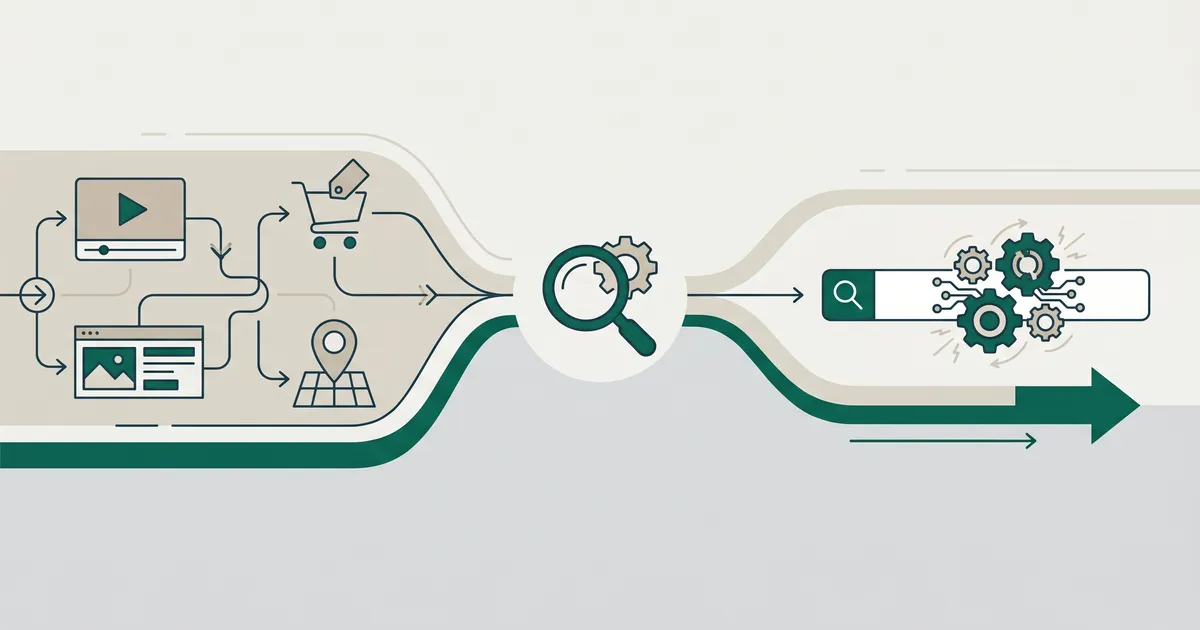
Performance Max and AI Max sound like the same product. They are not. Performance Max is a standalone campaign type that runs across every Google surface from one budget. AI Max for Search is a set of features that sits on top of a normal Search campaign and changes how matching, creative and landing pages work.
If you take one thing from this article, take that. The rest covers what each one actually does in 2026, where they fail, and how to decide between them.
We run paid marketing and Google Ads management for clients on both sides of this split, so the recommendations below come from what we configure when a new account lands on our desk, not from Google's marketing copy.
What Performance Max actually does in 2026

Performance Max takes your conversion goals, your budget and a pool of creative assets, then serves ads across YouTube, Display, Search, Shopping, Discover, Gmail and Maps. It chooses the channel, the format, the audience and the bid. You provide the inputs and the guardrails.
By early 2026 it accounts for roughly 45 per cent of all Google Ads conversions, and adoption among surveyed advertisers jumped from 60 per cent in 2024 to 71 per cent in 2025. That scale is exactly why the "black box" debate matters.
The transparency upgrades that changed the argument
Google shipped more PMax transparency features in 2025 than in the three years before combined. The ones that actually changed how we manage campaigns:
- Channel-level reporting, so you can finally see how Search, Shopping, YouTube and Display each performed inside a single PMax campaign.
- Full search term reporting for Search and Shopping placements.
- Campaign-level negative keywords, expanded to 10,000 terms in March 2025, matching standard Search campaigns.
- Search themes expanded to 50 per asset group.
- Asset-level reporting with impressions, clicks and cost data.
- Account-level placement exclusions in January 2026, covering PMax, Demand Gen, YouTube and Display from one list.
- Video assets per asset group raised from 5 to 15, plus a beta for A/B testing different asset sets inside one PMax campaign.
You can also generate image and video variations with Google's Asset Studio (Imagen 4 and Veo) and test them against human-produced creative inside the campaign.
What still isn't visible
PMax is more accountable than it was. It is not transparent.
Negative keywords only apply to Search and Shopping inventory inside PMax. Display, YouTube and Gmail can be 40 to 70 per cent of the spend, and they ignore your negative list entirely. A January 2026 investigation also found that PMax, Demand Gen and Display campaigns buy X (formerly Twitter) inventory programmatically through Search Partners and Video Partners extensions, regardless of internal brand policies.
The default failure mode
Without deliberate asset group architecture, audience signals and exclusion lists, PMax will claim your brand search traffic and pile spend into cheap Display impressions. Aggregate numbers look good. The incremental contribution is much smaller than the dashboard suggests.
This is where data-driven digital marketing earns its name. Separate brand from non-brand, watch channel-level reporting, and feed first-party audience data in as signals rather than letting the system guess.
What AI Max for Search actually does
AI Max is not a campaign type. It is a setting on a Search campaign that turns on three behaviours.
Announced at Google Marketing Live in May 2025, rolled out globally through beta in Q3 2025, it is now available across Google Ads, the Editor, Search Ads 360 and the API. According to Google, hundreds of thousands of advertisers are already running it at scale.
The three features and what they control
Search term matching. Expands beyond your existing keywords using broad match and keywordless technology. Google's AI reads your current keywords, creative and landing page URLs, then finds new queries it considers relevant. You can guide this with up to 25 search themes per campaign.
Text customisation. Generates new headlines and descriptions based on the landing page, the existing ads and the keyword set. This is the rebranded "automatically created assets".
Final URL expansion. Picks the destination URL for each query, choosing from indexable pages on your domain rather than the one you set.
Google reports that the full feature suite produces around 7 per cent more conversions or conversion value at similar CPA or ROAS compared to using search term matching alone. The figure is from Google internal data, 2026, and applies to non-retail advertisers. Retail results will differ. Treat it as directional.
The default-on problem you need to know about
This is where AI Max bites people.
URL expansion is on by default. Text customisation is on by default. Google has been auto-enrolling existing campaigns through recommendations and auto-apply. If you do not actively disable URL expansion or set exclusion lists, AI Max will send paid traffic to any indexable page on your domain, including your blog, your careers page and old landing pages you forgot existed.
Volume goes up while lead quality collapses. CPA looks fine while the sales team wastes hours on junk. That is the classic AI Max failure mode for lead gen.
For ecommerce with thousands of product pages and clean URLs, expansion can genuinely help. For B2B and lead gen with a small number of high-value conversion pages, it is usually a trap unless you carefully configure URL inclusions and exclusions first.
Two newer guardrails help. Term exclusions let you specify words and phrases the AI must never use. Brand guidance accepts natural language instructions about voice and messaging. Text guidelines began rolling out in limited beta in late 2025 and are expanding through Q1 2026, and Google has confirmed they apply to Performance Max too.
The DSA sunset: a hard deadline in September 2026
If you still run Dynamic Search Ads, pay attention here.
From September 2026, you will not be able to create new campaigns using Dynamic Search Ads, automatically created assets or the campaign-level broad match setting via Google Ads, the Editor or the API. Existing campaigns using these features will be auto-upgraded to AI Max.
Here is what changes in the migration:
- Dynamic ad groups become standard ad groups.
- Settings and historical performance data are ported across.
- All three AI Max features (search term matching, text customisation, final URL expansion) are enabled.
- Legacy URL controls are preserved, so if you had a tight DSA URL list, that carries over.
The risk is not that things break. The risk is that an account running on autopilot for years suddenly gains three new automated behaviours, and nobody notices until quality drops. If you have DSA campaigns running, do the audit now: review URL exclusion lists, set term exclusions, write brand guidance, and decide whether final URL expansion should be on at all.
Get plain-English guides like this in your inbox.
One short email a month. WordPress, Shopify, SEO, no fluff. Unsubscribe in one click.
We never share your email.
Which one should you use
If you sell products with a large catalogue and have decent visual assets, Performance Max is the heavier hitter, because it can use Shopping, YouTube and Display together. If you sell services, run lead gen or operate in B2B, AI Max for Search gives you the AI benefits without surrendering keyword-level reporting or sending traffic to pages you did not choose. If both descriptions fit, run them alongside each other and let the shared conversion data train both.
That last point reflects Google's own "Power Pack" framing from Google Marketing Live 2025, which treats Performance Max, Demand Gen and AI Max for Search as complementary layers covering different parts of the funnel rather than competing options.
Some practical pairings:
- B2B lead gen with a clear set of conversion pages: AI Max for Search with URL expansion disabled, plus a small Performance Max campaign restricted to your audience signals.
- Ecommerce with a large feed: Performance Max as the workhorse, plus AI Max for Search on your highest-intent product and category terms. Ecommerce marketing fundamentals covers the feed and conversion plumbing this depends on.
- Existing remarketing programme: keep Google Ads remarketing running as audience signals into both, rather than treating remarketing as a separate strategy.
For retailers, Google has also launched AI Max for Shopping campaigns, which use Merchant Center feeds to answer conversational queries and capture long-tail product searches that standard Shopping campaigns miss. Worth a controlled test if your feed is in good shape.
Your role has changed
The work is different now. Less time on bid adjustments, manual keyword pruning and A/B testing individual ad copies. More time on the things the AI cannot do for you:
- Conversion strategy. What you count as a conversion, and how heavily you weight it, is the single biggest lever. The AI optimises toward what you measure. Measure the wrong thing and it will efficiently waste your budget.
- Creative strategy. PMax and AI Max are only as good as the asset pool you give them. Strong headlines, clean product imagery and short-form video are the raw material.
- Audience and first-party data strategy. Customer match lists, lapsed customer segments and retention goals matter more than placement-by-placement bid tweaks ever did.
- Governance. Term exclusions, brand guidance, URL controls, placement exclusions, channel-level monitoring. The defaults are not safe. You are the safety layer.
The Gemini-powered AI Brief, rolling out across AI Max for Search and then PMax and AI Max for Shopping, lets you describe your business, your message and your audience in natural language and use that to steer the system. It does not remove the need for governance. It changes the interface for it.
If you want to see how we structure this for clients, see how we approach paid campaigns across both product types.
One thing to do this week
Open every Search campaign in your account and check whether AI Max features are on. If they are, check whether final URL expansion is sending traffic to pages you would not have picked yourself. That single audit catches more wasted spend than any bid strategy change.