
The time horizon nobody shows you
Most page builder decisions get made on an eighteen-month horizon, then the site lives for five years. That mismatch is where the real cost hides. Elementor, Divi and WPBakery all look reasonable on day one. The bill arrives later: slower pages, harder migrations, more security patches and staff who cannot maintain what the last person built.
This is not a builder-bashing piece. Builders solve a real problem. They let marketing teams ship pages without waiting on developers. The question is whether that speed is worth the compounding cost you never quoted for. Below is how the trade-off actually plays out at year one, year three and year five, and how we make the call on client web design and development projects at Devonic.
The performance gap is measurable
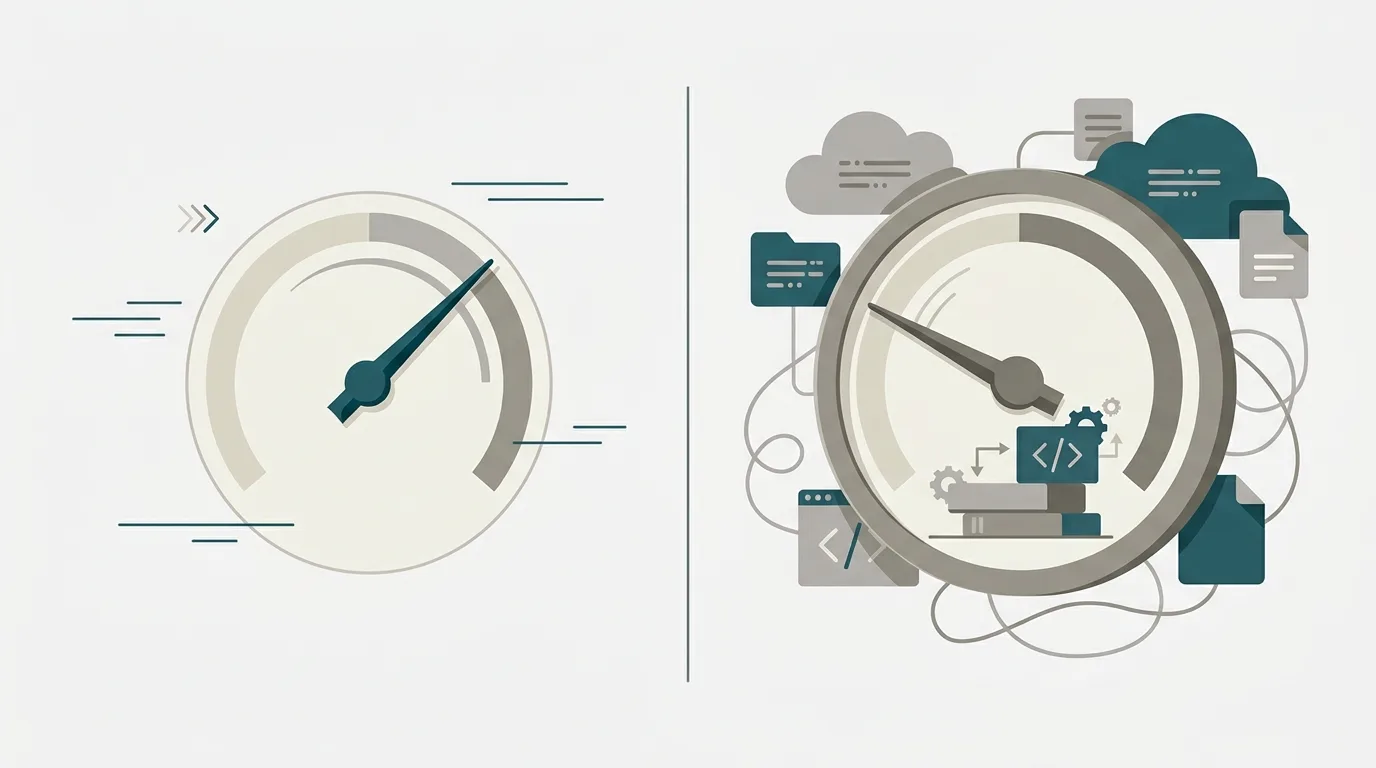
A 2025 HTTP Archive analysis put the median website builder site at 62 on Google PageSpeed Insights for mobile, against 85 for custom-built sites on modern frameworks. That gap is not folklore. It comes from a specific mechanism: builders inject platform JavaScript, ship CSS for template features you do not use, and wrap content in dozens of extra DOM nodes.
Elementor is the clearest case. It can add more than 21 MB of unzipped code to a WordPress installation. Each widget loads its own CSS regardless of whether you use it, and its JavaScript blocks the main thread during page load. In field data, Gutenberg sites on lightweight themes consistently hit a median mobile LCP under 2.0 seconds. Elementor sites before optimisation typically land between 3.8 and 5.2 seconds. Almost the entire difference is render-blocking CSS and JavaScript.
Core Web Vitals pass rates tell the same story with more texture. Duda passes at 85 percent. Wix passes at 71 to 75 percent. WordPress as a whole passes at only 43 to 45 percent. That last number deserves attention: a badly built custom WordPress theme is not automatically better than a well-configured builder. Craft matters.
What INP changed in 2024
In March 2024, INP officially replaced FID as a Core Web Vital. INP measures interaction latency across the whole session, not just the first tap. Builder-heavy sites take a much harder hit under INP because their JavaScript keeps running long after first paint. Every animation library, every hover effect, every third-party widget adds work to the main thread. If your site was scraping a pass under FID, INP is where it starts failing.
For the full playbook on tuning what you already have, see our guide to Core Web Vitals and site performance.
Mitigation is not a fix
Elementor and Divi both ship "Optimised DOM Output" and "Optimised Asset Loading" settings that partially close the gap. Combined with WP Rocket, aggressive image handling and pruned widgets, we have taken client Elementor sites from 3s LCP into the low 2s range. That is remediation. It buys time. It does not change the architecture. If Core Web Vitals are a revenue lever for you, plan a rebuild on your own terms rather than scramble when rankings drop.
Lock-in and the exit cost you never quoted
The clearest way to see builder lock-in is to imagine turning the plugin off. With Beaver Builder, your text stays in the standard editor. With Divi or Elementor, you get broken shortcodes and unformatted text. That difference has direct commercial consequences.
If you leave Divi or Elementor, you will be left with a mess of broken shortcodes or unformatted text.
Two patterns we see repeatedly:
- Elementor's copy-on-create templates. A 200-page brochure site with 30-plus Elementor templates has no template inheritance. Adding a single new field to the "case study" layout means editing 200 pages by hand. Agencies bill quarterly maintenance for years off exactly this friction.
- Divi's module-bound shortcodes. A broker on Divi for eight years found that switching themes meant manually rebuilding every page. Divi shortcodes are bound to Divi modules. No migrator preserves layout fidelity, because there is nothing standard to migrate to.
When a client asks us about migrating from WordPress to Next.js without losing SEO, the first question we ask is which builder the current site uses. That answer sets the migration scope more than anything else. Divi and Elementor content typically has to be rebuilt page by page. Gutenberg content maps cleanly into structured components.
Why Gutenberg is the least-bad middle ground
If you want the speed of a visual editor and the portability of native WordPress, Gutenberg is the answer. Block content is stored as HTML with comment delimiters. It survives theme changes. It exports cleanly. A custom theme built on native blocks and ACF gives marketers a visual editing experience without tying your content to a plugin vendor's rendering engine. That is the model we default to for brochure and editorial WordPress work, and the same model that makes headless WordPress with Next.js viable when performance requirements tighten.
Security surface area scales with plugin count
Every plugin is a codebase you did not write, maintained by people you cannot page at 3am. The security maths is unforgiving.
Elementor had multiple disclosures in 2024 and 2025. The most severe was CVE-2024-28847 in Elementor Pro, a remote code execution flaw with a CVSS score of 9.8, affecting more than five million websites. A King Addons for Elementor exploit late in 2025 triggered over 48,400 blocked attempts against monitored sites. Third-party add-ons compound the risk because each one is a new attack vector maintained by a smaller team.
The broader WordPress context matters. WordPress powers 43 percent of the web, which makes it the biggest target for automated attacks. The Sucuri 2024 report found WordPress accounted for over 95 percent of infected CMS sites they analysed. That is not a WordPress-is-broken argument. It is a your-surface-area-is-huge argument.
A custom theme paired with ACF (the real Advanced Custom Fields, with two million installations and a strong track record) presents a much smaller surface. Fewer plugins, no third-party rendering engine, no builder-specific animation libraries.
Watch the name confusion
A separate plugin called "Advanced Custom Fields: Extended", which is not the core ACF product, had a critical RCE vulnerability disclosed in late 2025. Check the plugin author, not just the plugin name, when auditing your stack.
Get plain-English guides like this in your inbox.
One short email a month. WordPress, Shopify, SEO, no fluff. Unsubscribe in one click.
We never share your email.
Technical debt compounds non-linearly
Almost nobody evaluates long-term technical debt when choosing a builder. That becomes the problem.
The pattern we see across client audits:
- Year one: the site ships fast. Marketers love it. Everything is fine.
- Year three: plugin subscriptions have accumulated. Two major WordPress releases have broken minor things. The person who understood the Elementor template hierarchy has left. Nobody wants to touch the header.
- Year five: the site fails Core Web Vitals on mobile. A rebuild quote lands. It is larger than the original build cost, because someone has to reverse-engineer the layouts before rebuilding them.
Two years in, the "economy" option has typically cost more in developer time, plugin subscriptions and lost opportunity than a custom build would have cost upfront. And it still does not perform as well.
The mechanism is the dependency cascade. Builders lock you into specific plugins the theme was built around. WordPress releases major updates two to three times per year, and each one occasionally breaks a theme or plugin. Skip updates and you invite compromise. Apply them and you inherit maintenance work. Neither path is free.
The people risk sits underneath all of this. Page builders let power users become de facto site owners. When they leave, they leave a system nobody else can pick up, because the documentation lived in their heads.
When a page builder is the right call
Builders win in specific situations:
- The site is a marketing surface, not a product. Landing pages, campaign microsites, content that ships weekly and gets rewritten quarterly. The debt never has time to compound.
- A non-developer needs to build pages daily. If your marketing team has to wait on engineering for every landing page, you have a bigger problem than DOM size.
- You have chosen a performance-conscious builder. Bricks Builder is the current leader on performance among builder options. Divi 5, released in late 2024, was a substantial rewrite with meaningfully better performance and a more modern editing experience. Neither closes the gap to a clean custom theme, but both narrow it enough to matter.
- The site will not exist in five years. A campaign site with a known end date does not need long-term thinking.
We have built and maintained plenty of Elementor and Divi sites for clients where those conditions held. The mistake is not choosing a builder. The mistake is choosing one for a site that will carry serious traffic for five years and treating the decision as purely a build-cost question.
How to make the decision for your site
Answer these questions honestly before choosing:
- How long will this site live? Under two years, builders are usually fine. Beyond three, custom starts winning on total cost.
- Who edits it, and how often? Daily non-developer edits push toward a builder or a Gutenberg-based custom theme with named patterns. Occasional structured content updates favour ACF and custom blocks.
- How much does organic traffic matter? If it is a primary channel, the Core Web Vitals gap is a competitive disadvantage that shows up in traffic reports, not invoices. INP makes that gap wider than it used to be.
- What is your migration tolerance in three years? If the answer is "we cannot afford to rebuild", do not choose Divi or Elementor. Choose Gutenberg with a custom theme, or go headless.
- Who owns the code? If your agency owns the theme and the plugin licences, you are locked in twice. Insist on ownership and portable content.
Our default recommendation for clients who need a WordPress site that will matter in five years is a custom Gutenberg theme with ACF, a lightweight parent, and only the plugins we can name a reason for. It is slower to build than dropping in Elementor. It is dramatically cheaper to own.
Before you rebuild
If you are not sure whether your current site is worth rebuilding or tuning, get a free website audit and we will show you where the actual bottlenecks are. Sometimes the answer is a rebuild. Sometimes it is a weekend of pruning.
Page builders are a legitimate choice for sites with a short horizon or heavy non-developer editing. For anything else, the upfront saving is a loan you repay with interest. Choose the tool that matches how long the site actually has to live, not how quickly you want to ship the first version.