
Why Bing's market share number misleads most marketers
The stat you have seen quoted is Bing's 5.14% share of global search. That number is technically accurate and strategically useless, because it blends mobile (where Bing barely exists) with desktop (where it matters), and it hides the countries where advertisers actually spend.
Look at desktop only and the picture changes. Bing holds 10.35% of global desktop search, 17.55% in the US, 14.4% in the UK and 15.4% in Canada. One in six or seven desktop queries in your largest English-speaking markets. The Microsoft Advertising network also serves Yahoo, AOL, DuckDuckGo, MSN and Outlook, and Bing is the default on more than 1.4 billion Windows devices. The reachable audience is not small.
The revenue confirms it. Microsoft's search and news advertising business generated an estimated $13.88 billion in 2025, projected to grow another 12.2% in 2026. That is not a niche curiosity. It is a channel most brands ignore because the headline number lets them.
The audience case: who actually searches on Bing
The stronger argument for Microsoft Ads is not that clicks are cheaper. It is that the person on the other end of the click is often a better match for a considered purchase.
Demographics that matter for B2B and high-ticket buyers
The median Bing user is 45 years old versus 38 on Google. Roughly 71% of Bing users are aged 35 to 65. Around 41% report household income of $100K or above, and about 32% hold a management-level position or higher, compared to 24% on Google. Microsoft's own audience data adds that its users are 34% more likely to be top household earners, and that 48% made a purchase in the past week.
For B2B specifically, Bing is used by 48% of Fortune 500 companies through Microsoft enterprise platforms. That is what "default search on managed Windows fleets" looks like in practice. If your ICP is a director-level buyer inside a large organisation, Microsoft's audience composition is a closer fit than Google's average.
A quick self-check
If your CRM shows most closed-won deals coming from desktop sessions, 35+ buyers, or job titles that include Director, VP or Head of, Microsoft Ads deserves a proper test. If most conversions come from a mobile-first, under-35 audience, the case is weaker.
The mobile caveat you need to know
Bing accounts for around 1.3% of global mobile search traffic. That is the honest limitation. Microsoft Ads is a desktop channel with mobile fill, not the other way round. For DTC brands whose funnel is 90% mobile, this dampens the volume case. It does not eliminate it, because desktop researchers who eventually convert on mobile are still valuable, but you need to instrument attribution well enough to see that cross-device journey. Fixing that measurement is a prerequisite, and we have written separately on fixing conversion tracking: server-side GA4 and why it matters for exactly this reason.
The CPC gap: structural, not accidental
The most consistently documented advantage is cost. According to Merkle's Q4 2025 Digital Marketing Report, the average CPC on Microsoft Ads is 33% lower than on Google Ads, and that gap has been stable for five years. It is also widening: the same measurement was 29% in 2024.
The reason is not quality. It is auction density. Fewer advertisers bid on Microsoft, so the second-price auction clears at lower prices for the same keyword intent. Microsoft also reports average cost per conversion running roughly 31% lower than Google in the same industries, which is what you would expect if traffic quality is broadly comparable and the input cost is lower.
Where the discount is largest
The gap is biggest in the verticals where Google is most crowded. Legal services show Microsoft CPC at $3.11 versus Google's $5.80, a 46% discount. Insurance is $2.79 versus $5.16, also 46%. Financial services sit at $2.58 versus $4.19 (38%), B2B and SaaS at $2.25 versus $3.44 (34%), e-commerce and retail at $0.88 versus $1.29 (32%), and hospitality and travel at $0.73 versus $1.02 (28%).
The CPC gap between Microsoft Ads and Google Ads grew from 29% in 2024 to 33% in 2025, and the discount is largest in legal and insurance at 46%.
As Google's auction gets more crowded, with Performance Max, AI Max and AI Overviews reshaping the SERP, pressure on Google CPCs increases while Microsoft's thinner auction stays cheap. We covered how that is playing out on the Google side in Google Ads in 2026: Performance Max and AI Max explained.
LinkedIn targeting: the capability Google cannot copy
Microsoft acquired LinkedIn in 2016, and the integration into Microsoft Ads is exclusive. You can apply LinkedIn profile data (job function, industry, company and, since June 2026, job seniority) as a bid modifier on a normal Bing search campaign. Typical adjustments run from plus 50% to plus 200% for matched profiles.
The mechanics matter. You are not paying LinkedIn's ad rates. You are running a keyword-triggered search ad, and when the searcher happens to be a matched profile, you bid up. Bottom-of-funnel intent combined with firmographic filtering. That is what B2B marketers have wanted from Google for a decade and cannot get.
A concrete example. You sell compliance software to financial services. Someone in the UK searches "SOX audit software". You bid your normal amount on that keyword and add a plus 150% modifier when the searcher's LinkedIn profile shows a Director or above role at a company in banking, insurance or capital markets. The ad still competes on relevance and quality score, but you have narrowed spend towards the people worth reaching. Google's audience layers cannot do this. They cannot see LinkedIn data at all.
Get plain-English guides like this in your inbox.
One short email a month. WordPress, Shopify, SEO, no fluff. Unsubscribe in one click.
We never share your email.
Copilot as an ad surface: promising but early
Microsoft Copilot is now the AI assistant embedded in Bing, Windows, Edge and Microsoft 365. Eligible ads appear inside Copilot's answers when users ask about services, brands or products, and Microsoft Advertising serves those placements.
Microsoft reports that Copilot-integrated ad inventory, launched in 2025 and expanded in 2026, is driving roughly an 18% year-over-year lift in ad revenue. Early advertiser reports suggest CTR and engagement on Copilot placements meaningfully exceed traditional Bing SERPs.
Treat this as directional rather than proven. Copilot performance data is still largely self-reported or vendor-estimated, and formats are changing quickly. What is worth doing now: make sure your campaigns are eligible for Copilot placements, tag them so you can segment performance later, and treat any Copilot spend as a test budget rather than a load-bearing channel. The interesting bet is that as Copilot becomes the default assistant on enterprise Windows fleets, a growing share of B2B research queries will flow through it.
The import-and-ignore trap
Roughly 72% of advertisers use Microsoft's Google Ads import feature. That is the good news. The bad news is that most clone the campaigns and never touch them again. That single habit is the biggest reason Microsoft Ads underperforms for brands that do try it.
The auction dynamics, audience composition and ad surfaces are different. Importing is a starting point, not a strategy.
What actually needs adjusting after import
Here is the practical checklist we work through on the first day of a Microsoft Ads engagement:
- Lower bids by 15 to 30%. Microsoft's own guidance. The auction is thinner, so Google-calibrated bids overpay.
- Split the Audience Network into its own campaign. Native placements on MSN, Outlook and partner sites behave very differently from search. Leaving them bundled hides the truth about both.
- Add LinkedIn profile targeting as bid modifiers on your highest-intent campaigns. Start with job function and industry, layer seniority once you have volume.
- Verify UET tracking fires on all conversion events, including any server-side setup. Imported conversion goals do not always translate cleanly.
- Review negatives and match types. Microsoft's close-variant behaviour is not identical to Google's, and imported broad match keywords can pull very different queries.
- Check product feeds and asset groups for Shopping and Performance Max equivalents. Merchant Center data does not always import complete.
- Measure the first 30 days on incremental conversions and CRM quality, not platform-reported conversions. The goal is to prove the traffic is real, then scale.
This is also where the incentive question matters. Agencies paid a percentage of ad spend have no reason to migrate you from expensive Google clicks to cheaper Microsoft ones. We have written on why a flat fee beats percentage-of-spend for PPC because it changes the recommendations you get.
Which businesses should prioritise Microsoft Ads first
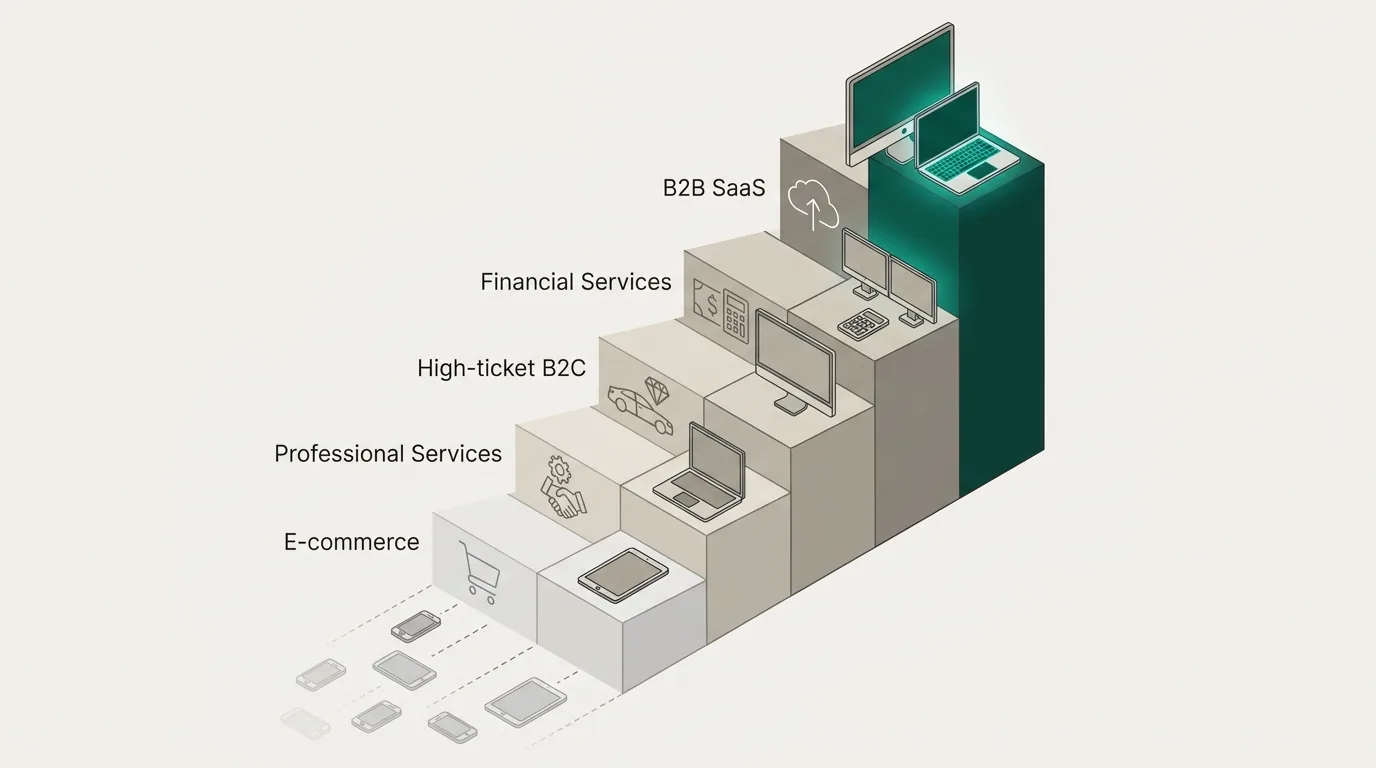
Not every brand should. In rough order of fit:
- B2B SaaS and enterprise software, especially anything sold to IT, finance or operations leaders inside large organisations. The Fortune 500 default-search overlap and LinkedIn targeting stack up.
- Financial services, insurance and legal, where the CPC discount is 38 to 46% and the audience skews older and higher-income.
- High-ticket, considered B2C, including bespoke travel, luxury goods, private healthcare and financial products. Desktop research still dominates these journeys.
- Professional services (accountancy, consultancy, specialist agencies) where buyers research on a work laptop and decisions are made by 35+ managers.
- E-commerce with strong desktop conversion, especially furniture, home improvement and premium apparel where the basket is high enough to justify desktop consideration.
The brands where we would not lead with Microsoft Ads: mobile-first DTC targeting under-25s, hyper-local services with tiny geographies where Bing volume dries up, and anything where the buyer never touches a desktop.
A note on how we set this up
Our paid marketing services treat Google and Microsoft as one strategy, not two channels bolted together. That usually means one shared measurement stack, LinkedIn modifiers on the Microsoft side from day one, and honest reporting on where each channel actually pulls its weight rather than a monthly slide that lists spend without incrementality.
If you want to see how we structure paid campaigns end to end, see how we approach paid campaigns across a few different verticals. The pattern is consistent: start with the buyer, work back to the channel mix, and refuse to run the channel you cannot measure.
Microsoft Ads is not a magic discount on Google. It is a different audience at a lower price with one exclusive B2B capability, and it rewards operators who treat it as its own channel rather than an import job. For most B2B and considered-purchase brands, that is a channel worth owning before your competitors notice.