
Most SEO advice treats topical authority as a vague reputation signal. It is not. It is a measurable pattern Google looks for: a site that covers one subject across many connected pages, structured around a pillar, supported by clusters, and tied together with deliberate internal links. Get the structure right and a small site can outrank older, larger domains on the niches it actually owns.
This is the practitioner's version. What works, what fails, and what it actually takes to ship.
What topical authority actually means
Topical authority is the degree to which Google trusts your site to fully cover a subject and its related subtopics. It is earned across many pages, not won by a single article. Domain authority, by contrast, is a third-party metric reflecting backlinks, age and technical health. The two are related but distinct, and the practical implication matters: a newer site with a tightly built cluster on a narrow subject can outrank an older domain that touches the topic once and moves on.
The mistake most teams make is treating topical authority as a content volume problem. Ten thin posts on adjacent keywords will not build it. Eight deep posts that genuinely answer the questions a knowledgeable reader would ask, linked together properly, will.
The short definition
Topical authority is what Google awards a site when its entire content footprint on a subject is consistent, deep and structurally coherent. Not one page. The whole footprint.
Why Google now rewards depth over domain age
This is not new behaviour. It is the endpoint of a decade of algorithm changes pulling in the same direction.
From keyword matching to semantic understanding
Google's 2013 Hummingbird update was the first major shift from string matching to meaning. Then came RankBrain, BERT and MUM, each one better at understanding how concepts relate to each other. The Knowledge Graph sits behind this work, functioning as a semantic database that maps entities and their relationships. When BERT reads your page, it does not just see words; it sees how those words fit a broader topic map Google already maintains.
That is why isolated articles struggle. A single post on "local SEO" surrounded by unrelated content looks accidental. Ten interlinked posts on local SEO subtopics, with consistent terminology and clear hierarchy, look intentional. Google's models can tell the difference.
How the June 2025 core update changed the calculus
The June 2025 core update reinforced this direction explicitly, rewarding sites that cover a subject thoroughly and credibly rather than relying on legacy domain signals. The December 2025 Helpful Content Update went further: sites with clear topic authority gained an average of 23% in organic visibility, while generic sites covering too many unrelated subjects lost roughly 18%.
The takeaway for operators is blunt but useful. If your site tries to be authoritative on twelve subjects, it is authoritative on none. Picking your battle is now part of the strategy.
The pillar and cluster model: structure before you write a word
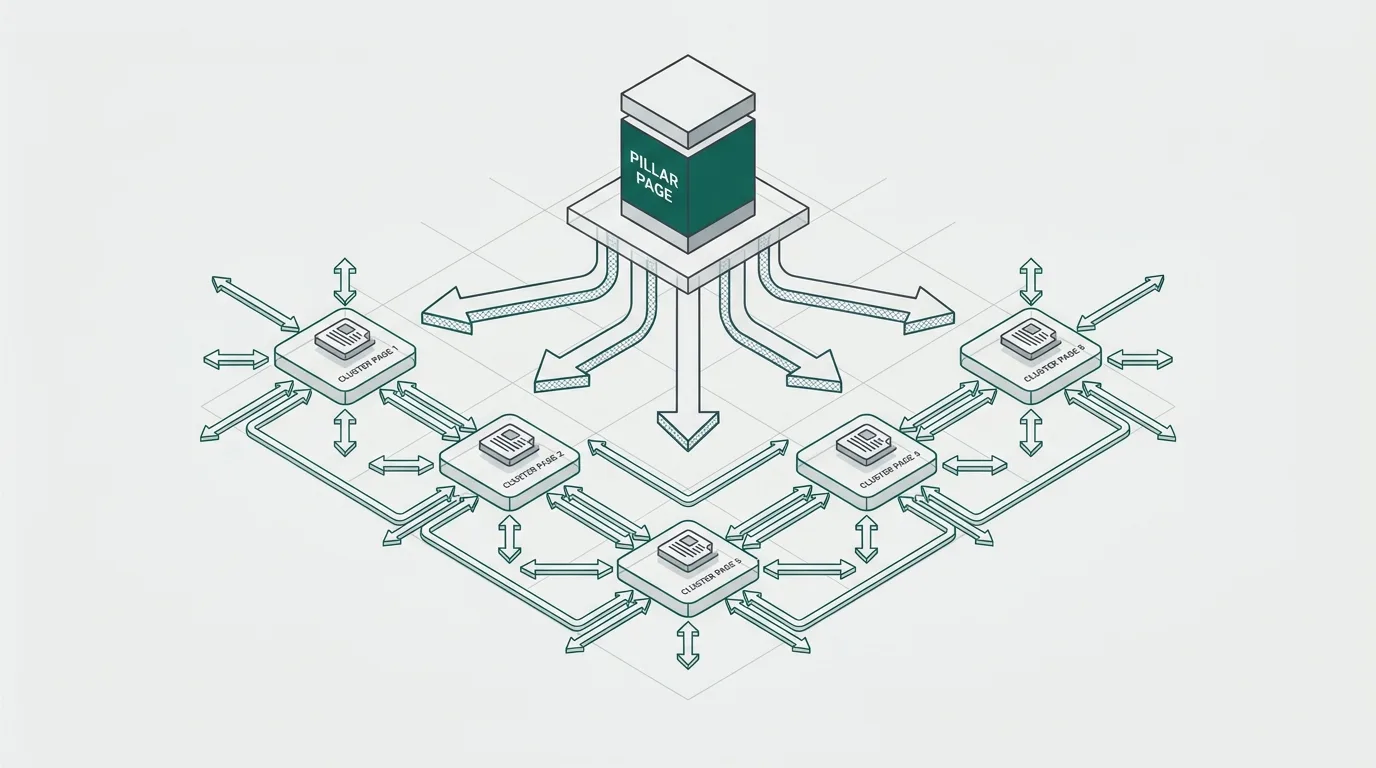
The model HubSpot formalised in 2017 still holds up because it matches how Google reads sites. A pillar page covers a broad topic comprehensively. Cluster pages cover subtopics in depth. Every cluster links to the pillar; the pillar links back to every cluster. The result is a defensible structure, not a pile of posts.
When HubSpot applied this to their own site, their domain authority grew from 49 to 60 and clicks for target keywords increased by more than 500%. More recent analysis from HireGrowth in 2025 found that clustered content drives about 30% more organic traffic and holds rankings 2.5 times longer than standalone pieces.
Building your topical map
The topical map is the blueprint. It is created before any writing, and it covers the main topic, all major subtopics, supporting questions, comparisons, definitions and FAQs. It is not a content calendar. It is a coverage document.
The practical method:
- Start with the pillar topic. It should be broad enough to support 8 to 12 distinct subtopics but narrow enough to align with what you actually sell or serve.
- Use Google's "People Also Ask", AlsoAsked and tools like Semrush's Keyword Strategy Builder or Ahrefs Content Explorer to surface the questions real searchers ask.
- Group the questions by intent: definitional, comparative, procedural, problem-solving.
- Mark which already exist on your site, which are gaps, and which overlap with existing pages. That last category is where future cannibalisation lives.
Plan first, write later
The single most common cause of weak clusters is publishing content first and trying to organise it afterwards. The map is the strategy. The articles are execution.
What a pillar page actually contains
A pillar page is the definitive guide on the topic. In practice that means roughly 3,000 to 5,000 words, covering every major aspect of the subject with enough depth to be useful and enough breadth to act as a hub. It should answer the broad question completely while leaving the granular sub-questions to cluster pages it links to.
A good pillar reads like the page you would send a colleague who asked, "where do I start with this?" A bad one reads like a table of contents pretending to be an article.
How cluster pages divide the depth
Each cluster page takes one subtopic and goes deeper than the pillar ever could. It targets a narrower set of keywords, addresses a more specific intent, and assumes the reader already knows the basics. The cluster is where you demonstrate experience: real examples, screenshots, the trade-offs you made, the mistakes you learned from.
This is also where E-E-A-T (experience, expertise, authoritativeness, trustworthiness) compounds. Our E-E-A-T SEO guide covers the mechanics, but the cluster format is where it actually shows up: named authors, lived experience, primary data and process detail across multiple pages on the same subject.
Internal linking: the mechanical backbone of a cluster
A cluster without disciplined internal linking is just a folder of related articles. The links are what tell Google the structure exists.
The rules are simple but non-negotiable:
- Every cluster page links to the pillar, ideally within the first 200 to 300 words, using descriptive anchor text that names the topic.
- The pillar links to every cluster page from contextually relevant sections, not from a dumped list at the bottom.
- Related cluster pages cross-link to each other, 2 to 3 times where naturally relevant.
- No "click here" or generic anchors. The anchor text is part of the semantic signal.
Authority Hacker's analysis of over a million sites found that proper internal linking can boost rankings by up to 40%. My Rankings Metrics' 2024 to 2025 analysis found pages within three clicks of the homepage generate nine times more SEO traffic than deeper pages. These are structural choices, not cosmetic ones.
Proper internal linking boosts rankings by up to 40%.
Internal linking also distributes link equity earned from external backlinks. A single strong backlink to a cluster page strengthens the pillar and every other cluster that page links to. That is how a cluster becomes a compounding asset rather than a one-off win.
Get plain-English guides like this in your inbox.
One short email a month. WordPress, Shopify, SEO, no fluff. Unsubscribe in one click.
We never share your email.
Keyword cannibalisation: the silent cluster killer
The most common way clusters fail is not under-publishing. It is over-publishing on overlapping intent. If you have three articles titled "best CRM software", "top CRM tools 2024" and "CRM software comparison", they are all competing for the same query. Google picks one (often the wrong one), splits the equity, and none of them rank where they should.
Content cannibalisation is the broader version: too many pages delivering overlapping value, even when the keywords differ. Both fragment the authority signal and undermine the cluster.
The fix is a cannibalisation audit before you publish anything new:
- Pull every existing page on the topic into a spreadsheet.
- Map each to a primary intent and primary keyword cluster.
- For any page ranking in positions 1 to 3, check semantic overlap with planned new content. If overlap exceeds roughly 45%, expand the existing page rather than create a new one.
- For overlapping mid-rank pages, merge them, 301 the loser to the winner, and consolidate the internal links.
Google Search Console's Performance tab, filtered by query, is the cheapest tool for spotting this. Ahrefs, Semrush and Yoast all have dedicated cannibalisation reports if you want it automated.
This audit is also where most teams discover their existing site is already fighting itself. Before you build a new cluster, fix the old one. If you want a starting point, our free website audit covers this as part of the review.
Topical authority and AI search citations
AI Overviews now appear in roughly 30% of Google search results and 74% of problem-solving queries. The same structural signals that earn traditional rankings also influence which sources LLMs cite, which is the entire premise behind generative engine optimisation.
The mechanism is pattern recognition. A site with ten linked, accurate articles on local SEO reads to a language model very differently than a site with one local SEO article surrounded by unrelated content. The clustered site looks like an expert source. The other looks like a site that happened to touch the subject once.
Two practical reinforcements help here:
- On the pillar page, use the
aboutschema property to identify the primary entity. - On each cluster page, use
isPartOfto explicitly link it back to the pillar.
This converts your cluster from a content organisation choice into a structured signal that AI systems can parse. Combined with the schema and crawl fundamentals in our technical SEO guide, the cluster becomes legible to both Google and the LLMs sitting on top of it.
A working cluster is also where investing in proper SEO services pays back. The strategy work, mapping, audit, internal linking discipline and ongoing maintenance, is what produces the compounding result. Writing articles in isolation rarely does.
Timeline, maintenance and realistic expectations
The timeline is the part most operators dislike, so it is worth being direct.
- Months 1 to 3: build the topical map, audit existing content, publish the pillar and the first half of the cluster. Rankings are largely flat. You are establishing coverage.
- Months 4 to 6: complete the cluster, fix internal linking across the site, start earning external backlinks to cluster pages. Initial ranking improvements appear, typically within 60 to 90 days of the cluster being complete.
- Months 6 to 12: compounding kicks in. Pages support each other, AI citations begin appearing, and the cluster starts behaving like a moat.
The 6 to 12 month window is a feature, not a bug. It is exactly why a well-built cluster is hard for competitors to replicate quickly. Paid traffic can be matched in a week. A two-year-old cluster of forty interlinked pages cannot.
Maintenance is not optional
Content ages. A cluster left untouched for two years loses authority because Google reads stale data as reduced helpfulness. Plan a quarterly review at minimum: factual updates, new questions added, dead links fixed, schema verified.
The pragmatic version of this work looks less like "writing content" and more like running a small ongoing publishing operation: a map, an audit, a publishing cadence, a maintenance schedule, and a discipline about what you will not write about. The teams that treat it that way get the compounding effect. The teams that treat it as a series of blog posts do not.
If you want a second pair of eyes on the structure of your existing content before committing to a cluster strategy, get in touch and we will tell you honestly whether you have an authority problem, a structure problem or a cannibalisation problem. Usually it is one of the three, and the fix is rarely "publish more".