
From strings to things: how Google actually reads your brand
Google stopped ranking strings of text and started ranking entities in 2013, when Hummingbird shipped. An entity is a distinct thing: a company, a person, a product, a concept, each with attributes (founding year, location, employees) and relationships to other entities. The Knowledge Graph is the machine-readable knowledge base that holds them. Google says it now contains over 500 billion facts about more than 5 billion entities, though some sources put the figure closer to 8 billion. Either way, the number that matters for you is one: whether your brand is in it, and how clearly.
Every major algorithm update since Hummingbird has moved Google further from keyword matching and closer to entity understanding. RankBrain in 2015, BERT in 2019, MUM in 2021, AI Overviews in 2024. A page can rank for "running shoes" without the phrase appearing anywhere on it, provided Google reads the entities and their relationships clearly. When Gemini generates an AI Overview, it draws directly from entity relationships already in the graph. If you are not there, or you are there ambiguously, you do not get cited.
That is the shift. The rest of this piece is how to act on it.
Why entity status now determines AI Overview citations
Here is the uncomfortable data point for anyone still treating brand-building as a soft channel. A 2025 Semrush study analysing AI Overview citations found branded web mentions correlate with citation frequency at r = 0.664, while traditional backlinks correlate at only r = 0.218. Roughly three times the signal strength, from being mentioned versus being linked.
The same study found 75% of AI Overview citations come from pages already ranking in the top 12 organic results, but the AI does not simply pick the number one. It picks the source it has the highest entity confidence in. That is why brands with weaker organic rankings sometimes outrank incumbents inside AI Overviews. Entity clarity beats position.
Treat this as one study, not settled consensus. But the direction of travel is consistent across every credible source: AI systems prefer entities they can identify unambiguously, and they penalise ambiguous or contradictory brand data with silence. The model would rather cite nothing than hallucinate you.
Brand mentions vs backlinks: what the signal data shows
The mechanical explanation is Named Entity Recognition. When Google crawls a page, its NLP algorithms extract entities, assess salience (how central each entity is to the topic) and map the relationships between them. Whether your brand is wrapped in an <a> tag or not does not change the fact that Google has read the mention and attributed it to your entity profile.
A mention of "Devonic Web" in a Smashing Magazine article, unlinked, still corroborates our entity. A backlink adds authority via PageRank. A mention adds entity trust. The two do different jobs, and for AI citation the mention now appears to be the stronger lever.
What the 2024 API leak confirmed (and what it didn't)
In May 2024, thousands of internal Google documents from the Content Warehouse API leaked, exposing roughly 14,000 ranking attributes. Two are worth naming. siteAuthority is a domain-wide authority signal, which contradicts years of Google's public statements that no such site-wide value exists. NavBoost is a click-based system that weights user interaction data.
The CompressedQualitySignals module bundles siteAuthority, pandaDemotion and navDemotion into what looks like a curated cheat sheet of high-priority signals. The leak also supports the view that entity mentions across the web can influence rankings similarly to backlinks.
Read the leak carefully
Google publicly cautioned that the documents may be out of context, outdated or incomplete. The existence of siteAuthority as a named attribute is confirmed. Its weighting inside the live ranking system is not. Treat the leak as directional evidence, not a spec sheet.
The entity build sequence
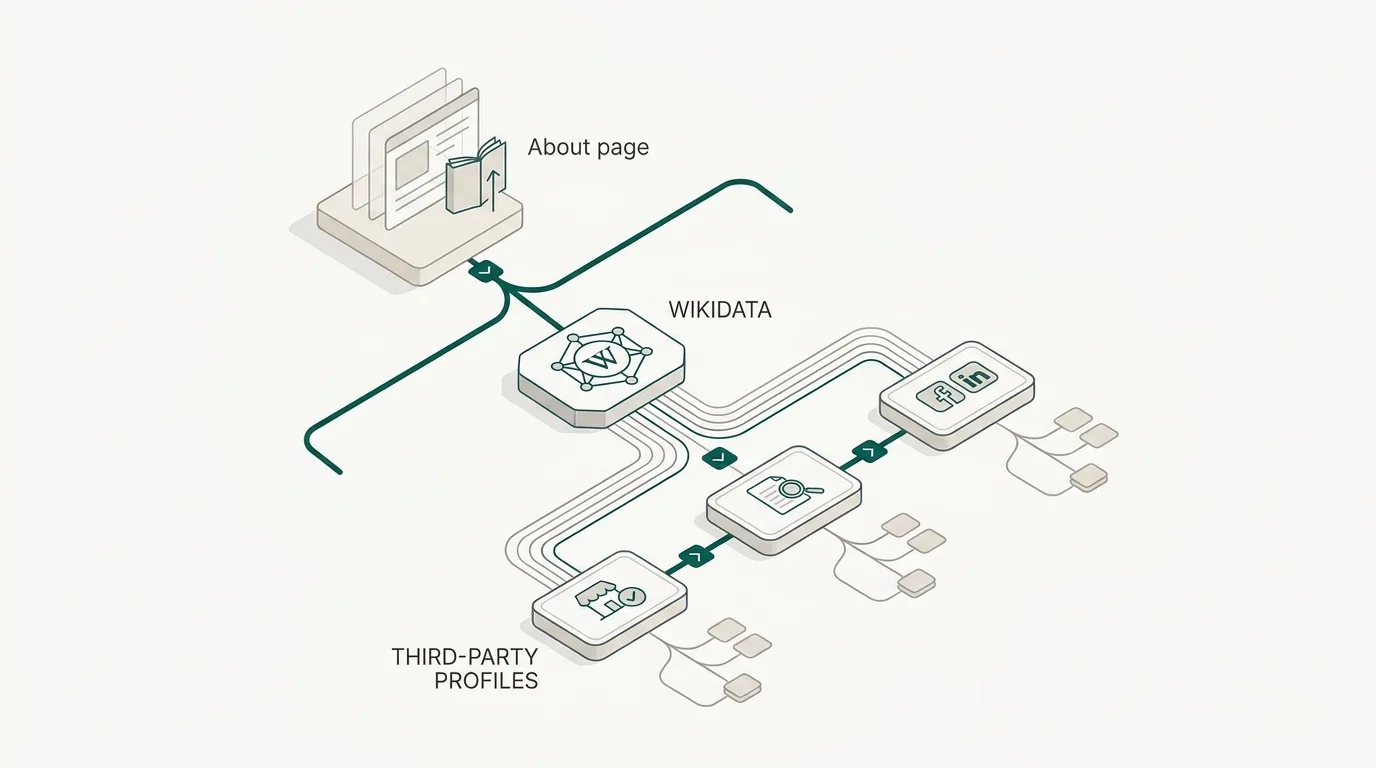
Here is the sequence we run for clients, in the order we run it. Steps out of order waste effort because later corroboration only counts if there is something coherent to corroborate.
Your entity home: the About page as canonical anchor
The concept of the entity home was formalised by Jason Barnard: a single canonical URL that anchors how algorithms, bots and people understand your brand. In practice, this is almost always your About page. That URL carries your Organization JSON-LD, an @id pointing to your canonical domain, and every sameAs declaration linking to your verified profiles elsewhere.
Everything downstream keys off this page. If you have five About-style pages competing on the same domain, or your Organization schema lives on the homepage while your bio content lives on /about, you are asking Google to guess. It will guess wrong, or it will hedge. For the mechanics of getting the JSON-LD right, we covered the detail in structured data and schema for rich results and AI citation.
Wikidata, sameAs declarations and third-party corroboration
Once the entity home is solid, the priority is Wikidata, not Wikipedia. Ahrefs put it well: getting listed on Wikidata is arguably more important than a Wikipedia page because it is considerably more achievable. Wikidata has a notability policy, but it is more permissive than Wikipedia's, and its structured statements feed Google's entity understanding directly.
A minimum-viable Wikidata item declares your organisation, your founding date, headquarters location, official website, industry, and key people, each statement backed by a source. From there, your sameAs declarations on the About page should link to the profiles that consistently describe the same entity: Wikidata item, LinkedIn company page, Crunchbase, G2, Companies House record, verified social profiles. Consistency is the point. Variations like "Acme Corp", "Acme Corporation" and "Acme" create disambiguation problems that slow entity recognition.
Google weights sources differently. An entity described consistently across Wikidata, Wikipedia and multiple structured data implementations is far more confidently recognised than one described only on its own website.
Here is the shape of a minimal Organization block that ties the entity home to third-party corroboration:
{ "@context": "https://schema.org", "@type": "Organization", "@id": "https://example.com/#organization", "name": "Example Ltd", "url": "https://example.com/", "logo": "https://example.com/logo.png", "foundingDate": "2019-04-01", "sameAs": [ "https://www.wikidata.org/wiki/Q000000000", "https://www.linkedin.com/company/example", "https://www.crunchbase.com/organization/example", "https://www.g2.com/products/example" ]}Brand mention outreach and the compounding layer
With the foundation in place, the ongoing work is what most people call digital PR, reframed for entities. You are not chasing links. You are chasing mentions in authoritative third-party content that describe your brand the way your entity home describes it.
Practical shape: expert commentary in trade press, guest analysis in industry publications, podcast appearances that generate transcribed mentions, inclusion in listicles and comparison pieces on established review sites, conference speaker bios. Each mention adds a corroborating description. The compounding effect is the mechanism behind entity confidence, and it is why entity SEO takes months to move, not weeks. If you want a broader view of how this connects to LLM citation, generative engine optimisation: how to get cited by AI Overviews and ChatGPT walks through the wider picture, and this is the mechanical layer we build into our SEO services engagements.
Knowledge Panels: a consequence, not the goal
A common misconception, especially among founders new to this: the goal is a Knowledge Panel. It is not.
An entity can exist in the Knowledge Graph without ever triggering a panel in search results. Panels appear only when Google is confident the entity is well-defined, has enough search demand, and has no overlapping entities creating disambiguation problems. Plenty of brands achieve full entity recognition (clean AI Overview citations, correct disambiguation, authoritative status on their topic) without a panel. Chasing the panel as a KPI drives the wrong behaviour. You end up optimising for visual output rather than the underlying signal quality.
There is a related point worth flagging. In June 2025 Google ran what has been called a "clarity cleanup", deleting over 3 billion ambiguous entities from the Knowledge Graph. Only well-corroborated, consistently described entities survived. If your entity data was noisy, you may have been trimmed. Track your visibility carefully. We covered the how in tracking your visibility in Google AI Overviews.
Get plain-English guides like this in your inbox.
One short email a month. WordPress, Shopify, SEO, no fluff. Unsubscribe in one click.
We never share your email.
The executive entity: why your founders need their own entry
Something quietly significant happened between 2023 and 2024: the number of people with Knowledge Panels roughly quadrupled, with C-level executives at major corporations disproportionately affected. From early 2025, corporate entity panels became far more available too, having existed almost exclusively for person entities for the previous five years.
The practical implication for a founder-led brand is that your CEO and founders are separate entities in the graph, and their entity strength amplifies the organisation's. Google increasingly surfaces key people inside corporate knowledge panels. If your founder has no Wikidata item, no consistent bio across LinkedIn, Crunchbase and conference sites, and no third-party mentions describing them the same way, you are leaving corroborating signal on the floor.
The mechanical connection is the employer property (P108 in Wikidata), which links a person entity to an organisation entity. Once both entities exist and are connected, you have two mutually reinforcing profiles rather than one. For founder-led B2B companies, this is often the single highest-leverage move after the entity home itself.
Where entity SEO is heading
Two directions to plan around.
First, multimodal entity recognition. Google is extending entity understanding beyond text into images, video and audio. Brands maintaining visual identity consistency, using structured metadata for media assets, and treating video captions and podcast transcripts as first-class content will benefit as the graph learns to read non-text representations of entities.
Second, AI systems are building their own entity graphs. ChatGPT, Claude and Perplexity increasingly reason over internal representations that complement, and sometimes compete with, Wikipedia and Wikidata. The winning move is not to optimise for one graph but to make your brand description so consistent across every authoritative surface (structured data, Wikidata, verified profiles, third-party editorial) that any system building any graph reaches the same conclusion about who you are.
A quick self-check
Run Google's Rich Results Test on your About page. Query the Knowledge Graph API for your brand name. Search your exact company name in an AI Overview surface and read the citations. If any of the three returns something ambiguous, inconsistent or blank, that is the first place to work.
Entity SEO is unglamorous plumbing. It decides whether the AI answer engines mention you or somebody else when the customer asks. If you want to see how we approach SEO for our clients, the entity layer is where most of our engagements start, before we write a single new page.